Canada Phone Number for OTP: How to Get a Virtual +1 Number
Need a Canada phone number for OTP? Get a private +1 virtual number, spot a Canadian area code, receive the code and fix codes that never arrive.
By the DuoTalk team · Published 2026-11-09 · Updated 2026-11-11
A Canada phone number for OTP is a +1 number with a Canadian area code that receives the one-time passcode a service texts you during sign-up or login. You need one when a service limits sign-up to Canada, checks that your area code is Canadian, or sends codes only to Canadian mobile numbers. The quickest private way to get one is a Canadian virtual number you read in an online inbox: a temporary one for a single code, or a monthly one for an account you will keep. This guide shows when a Canadian number is truly required, how to tell it apart from a US number (both start with +1), how to receive the code step by step, and how to fix the usual reasons a Canadian OTP never arrives, as of November 2026.
The short answer: Use a Canadian +1 virtual number when a service asks for Canada specifically or rejects US area codes. Pick a temporary number if you need one code and will never log in again, and a monthly number if the service will text you again. Enter the 10 digits with "Canada" selected, request the code once, and read it in your private inbox; if nothing comes, change the number rather than tapping "Resend".
What a Canada phone number for OTP actually is
A Canada phone number for OTP is any +1 number whose area code belongs to Canadian numbering and that can receive a text message containing a one-time code. The code itself is the same kind of 4 to 8 digit passcode any service sends; only the number's country changes.
Every Canadian number has 10 digits after the +1: a 3-digit area code, a 3-digit exchange (called the central office or CO code) and a 4-digit line number. Written in international format it looks like +1 604 555 0142. Canada has no country code of its own. It shares +1 with the United States and several Caribbean countries under the North American Numbering Plan, run by the North American Numbering Plan Administrator. In Canada, the CRTC (the telecom regulator) decides on new area codes, and the Canadian Numbering Administrator assigns exchange blocks within them to carriers.
There are three ways to hold a Canadian number that can receive an OTP:
- A Canadian SIM or eSIM from a carrier: the most trusted line type, but it needs a plan, a compatible phone and often a Canadian address.
- A free app number from a calling app: covered in our guide to free Canadian phone number options, with its limits.
- A paid Canadian virtual number: a +1 number bought online, with codes shown in a private web inbox. This is the option this guide focuses on, because it is what most people mean by a temporary Canada phone number or a Canada virtual phone number for verification.
If you are new to the idea of reading codes in a browser, our guide on how to receive SMS online privately explains the whole category, including the risks of public inbox sites.
Temporary and monthly Canadian numbers
A temporary Canadian number is meant for one verification and expires within the hour; a monthly Canadian number stays yours for 30 days so later codes still reach you. On DuoTalk (theduotalk.io, a web app to receive SMS online on private virtual numbers), the two work like this:
| Temporary (short-term) Canadian number | Monthly Canadian number | |
|---|---|---|
| How long it works | 60 minutes from purchase | 30 days |
| After the first code | Stays open 7 more minutes for a second code | Keeps receiving until the 30 days end |
| Which services can text it | Only the one service you chose at purchase | Any service |
| If no code arrives | Extend once for free (another hour, same number); if it still fails, report it and the money returns to your balance | Refund on request within 48 hours if the number never receives an SMS |
| Renewal | Not renewable | Renew from your numbers list before day 30; nothing renews automatically |
| Availability | Live stock by service on the Numbers page | Some countries only; check whether Canada is offered |
Both are receive-only. They take SMS, they cannot send texts and they cannot answer calls, so a "Call me with the code" option will not work on them.
When a service needs a Canadian number specifically
A service needs a Canadian number when its sign-up only offers Canada in the country picker, when it says outright that international numbers are not supported, or when it checks the area code and rejects anything outside Canada. If the form accepts "+1" without asking which country, a US number usually works just as well.
The signals are easy to read once you know them:
- The country picker is fixed. The phone field shows a Canadian flag and "+1" with no dropdown. That is a Canada-only sign-up.
- The error names the country. Wording varies, but messages like "Please enter a valid Canadian phone number" or "International numbers are not supported" mean the area code was checked.
- The app is Canada-only. Many Canadian services (rent and bill payment apps, regional delivery and loyalty apps, provincial services) are built for residents and verify that the number is Canadian. Chexy, a Canadian rent payment app, says in its help centre that it requires a Canadian number "for security and compliance purposes" and that SMS verification "cannot be bypassed."
- The region of your account is Canada. Some global apps tie your store, currency or content region to the country of the phone number, so a Canadian number keeps the Canadian version of the account consistent.
When a US number is fine instead
A US number is fine when the service accepts any +1 number and does not check whether the area code is Canadian or American. Most global apps fall into this group: they ask for "+1", send the code, and never look at the province. If you are not sure, read the country list in the phone field. A single "+1" entry, or separate "United States" and "Canada" entries that both accept any +1 number, means either country works, and you can pick whichever has stock and the better price. Our guide to a temporary US phone number covers that route.
When you should not use a virtual Canadian number at all
Some Canadian accounts should stay on a phone line you own for years, and a few are better protected without any phone number.
- Banks, credit cards and payment apps. Use your own Canadian mobile number, follow the institution's identity rules, and keep the number for as long as you keep the account.
- Government accounts. The Government of Canada's GCKey help page lists an authenticator app or an email address as the two-factor methods for GCKey. If a public service gives you the choice, an authenticator app is the stronger option and needs no number at all.
- Anything that would breach a service's terms. Do not use any number to create accounts in bulk, get round a ban or pass identity checks you could not pass with your real details.
| Situation | Canadian number needed? | Best number type |
|---|---|---|
| Canada-only app with a fixed +1 Canada field | Yes | Monthly, if you will log in again |
| Global app that accepts any +1 number | No, a US number also works | Temporary for one code, monthly to keep |
| Testing your own app's Canadian SMS flow | Yes, for realistic area codes | Temporary per test, monthly for repeated tests |
| Classified or marketplace listing you want to keep separate | Often | Monthly |
| Bank, credit card, payment or crypto exchange account | Yes, but use your own | Your own Canadian SIM or eSIM |
| GCKey or other government sign-in | Usually not | Authenticator app |
How to tell a Canadian number from a US number
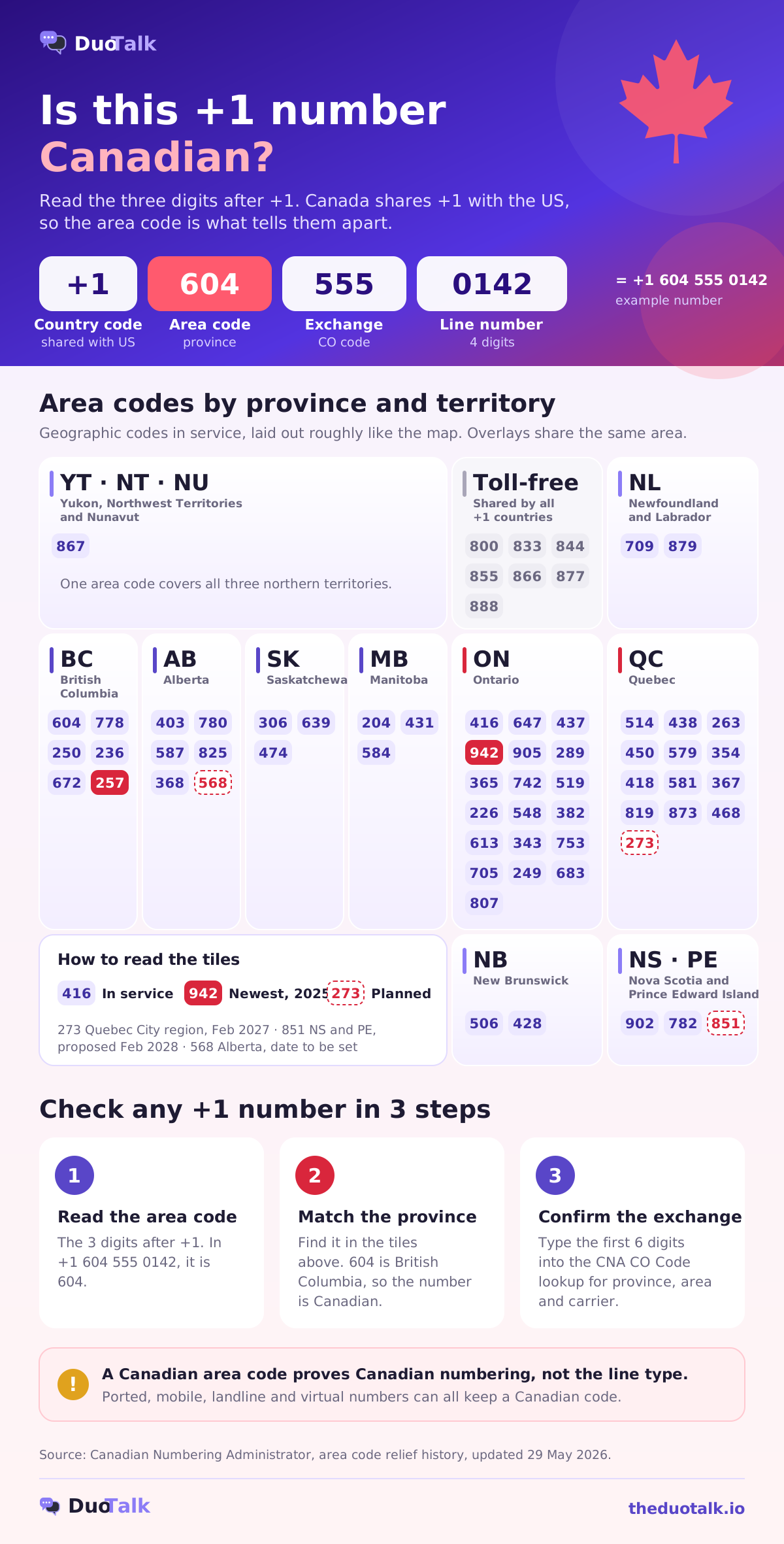
You tell a Canadian number from a US number by its area code, the first three digits after +1. If those digits belong to a Canadian province or territory, the number comes from Canadian numbering; the format is otherwise identical to a US number.
This matters twice: when you choose a number, and when a code fails and you need to rule out an area code the service does not see as Canadian.
The three-check method
- Read the area code. For +1 604 555 0142 that is 604, a British Columbia code. For +1 212 555 0142 it is 212, New York, so not Canadian.
- Match it to a province. The infographic below groups every geographic area code in service by province and territory. The Canadian Numbering Administrator's area code relief history (updated 29 May 2026) is the official record and counts 56 Canadian geographic area codes assigned as of that date.
- Confirm the exchange if you need certainty. Type the area code and the next three digits into the CNA's CO Code / Phone Number Lookup. It returns the province, the exchange area and the company that received that block.
That last step has a limit worth knowing. The CNA states that it has no listing of individual telephone numbers and does not know which numbers were ported to another provider. A Canadian area code proves the number is Canadian; it does not tell you whether the line is a mobile SIM, a landline or a virtual number. That is why many services also run a line-type check, which we come back to in the troubleshooting section.
Codes that are newest, and codes that are not Canadian
The newest Canadian codes are 942 (Toronto, April 2025) and 257 (British Columbia, May 2025). Overlays cover the same territory as the older code, so 942 is as much "Toronto" as 416, and 257 is as much "British Columbia" as 604. Some older validation lists inside apps lag behind the CNA, so a brand-new code can occasionally fail a format check even though it is perfectly valid. If that happens, a number with an older code from the same province usually passes.
Planned codes are already on the record: 273 for the Quebec City region (February 2027), 851 for Nova Scotia and Prince Edward Island (proposed for February 2028) and 568 for Alberta (date to be set).
Toll-free codes such as 800, 833, 844, 855, 866, 877 and 888 are shared across the whole plan and do not show a country. They also rarely receive verification texts. For a sign-up code, use a geographic Canadian area code.
Temporary or monthly: choosing the right Canadian number for your OTP
Choose a temporary Canadian number if the service will text you once and never again; choose a monthly Canadian number if you will log in again, change devices, or might need a password reset. The deciding question is "Will this service ever send me another code?" If the answer is yes or "not sure", go monthly.
The difference only shows up later, which is why people get it wrong. A temporary number delivers the sign-up code perfectly. Three weeks later the service sees a login from a new laptop, texts a code to the same number, and nobody receives it because the number expired. On a Canadian-only app that also blocks US numbers, you may have no easy way back in.
Worked examples
- Marta in Lisbon, trying a Canadian grocery app once. She wants to see the app's Canadian prices and will delete it after a week. A temporary Canadian number is enough. If no code arrives, she extends once for free, then reports the number and the money returns to her balance.
- Kofi in Calgary, listing furniture on a local marketplace. He wants buyers to reach the account without seeing his personal number, and the site re-verifies on new devices. A monthly Canadian number he renews from his numbers list before day 30.
- A QA engineer in Montreal testing a sign-up flow. She needs real Canadian area codes to confirm the app's validator accepts 263 and 438 as well as 514. A temporary number per test run, or a monthly one if the test account must survive between releases.
What each choice costs you if you guess wrong
| You chose | And later | What happens |
|---|---|---|
| Temporary | Service asks for a code on a new device | The number has expired; you rely on email or backup codes, or lose the account |
| Temporary | You want to change the phone number on the account | Many services text the old number first; you cannot confirm |
| Monthly | You only ever needed one code | You paid for more days than you used; let it lapse with no automatic charge |
| Monthly | You forgot to renew before day 30 | The number ends; renew earlier next time, from your numbers list |
For a deeper look at this trade-off across all countries, see our comparison of one-time vs monthly virtual numbers.
How to receive an OTP on a Canadian virtual number, step by step
To receive an OTP on a Canadian virtual number, buy a +1 Canada virtual phone number for the service you are signing up to, type its 10 digits into the service with Canada selected, request the code once, and copy it from your private inbox. The whole flow usually takes two to three minutes. Here it is on DuoTalk.
- Decide temporary or monthly. Use the question from the previous section. For a bank, payment app or government account, stop here and use your own number or an authenticator app.
- Open the Numbers page. Go to live Canadian numbers on the Numbers page, search for the service you are verifying (or choose "any" for a monthly number), and select Canada. You see live stock and the live price. If Canada shows no stock for that service, check again later, or use a US number if the service accepts any +1.
- Top up your balance if needed. DuoTalk accepts crypto only: USDT on TRC20 or BEP20, TRX, LTC, BTC or ETH. The minimum top-up is $15, and the balance is added automatically once the network confirms. No fees or tax are added at checkout; the price you see is paid from your balance. Our top-up guide walks through each coin.
- Get the number. Press Get Number and confirm. The number appears with its +1 prefix, its Canadian area code and a live timer (60 minutes for a temporary number).
- Enter it on the service. Pick "Canada" in the country list if there is one, then type only the 10 digits, for example 604 555 0142. Do not add an extra 1 or 0 in front, and check that the service did not keep "United States" from an earlier attempt.
- Choose SMS, not a call. If the service offers "Text me" or "Call me", pick text. Virtual numbers here receive SMS only.
- Request the code once. Codes usually arrive within seconds on tested routes. Give it two full minutes before you do anything else. Repeated "Resend" taps can trigger a rate limit that blocks every number for a while.
- Copy the code from your inbox. Paste it into the service before it expires; many OTPs are valid for only 5 to 10 minutes. If the service sends a second code, a temporary number stays open 7 more minutes after the first.
- If nothing arrives. Extend once for free for another hour on the same number. If it still fails, report it and the money goes back to your DuoTalk balance. The help page on what to do when no SMS arrives shows exactly where these buttons are.
One honest limit applies to every provider: a code arriving is not the same as acceptance. A service can still refuse a number after sending a code, and services change their rules without notice.
Entering a Canadian number in the right format
The safest format is the 10 digits alone with Canada chosen in the country picker; if there is no picker, use +1 followed by the 10 digits. Most "invalid number" errors on Canadian numbers are format errors, not number problems.
| How you typed it | Result on most forms | Fix |
|---|---|---|
| 604 555 0142 with Canada selected | Accepted | None needed |
| +16045550142 in a field with no picker | Accepted | None needed |
| 1 604 555 0142 with Canada selected | Often "invalid" (the 1 is counted twice) | Remove the leading 1 |
| 0604 555 0142 | "Invalid" (Canada has no trunk 0) | Remove the 0 |
| (604) 555-0142 | Usually accepted; some fields reject brackets | Type digits only |
| 604 555 0142 with United States selected | Accepted as +1, but a Canada-only service may reject the area code | Switch the picker to Canada |
Receiving codes from outside Canada
You can receive an OTP on a Canadian virtual number from anywhere, because the SMS is delivered to the provider's side and shown in your online inbox. Your location, Wi-Fi or roaming status does not affect delivery to the number.
Two things can still differ when you are abroad. First, some services compare the number's country with your IP address or device region and add an extra check, or refuse the sign-up, when they do not match. Second, some Canadian services serve residents only, and a Canadian number does not change who they will serve. Follow each service's rules; a number is not a way round location or identity requirements. Comparing countries for a trip? The UK guide to receive SMS online follows the same structure for +44.
Why a Canadian OTP fails, and how to fix it
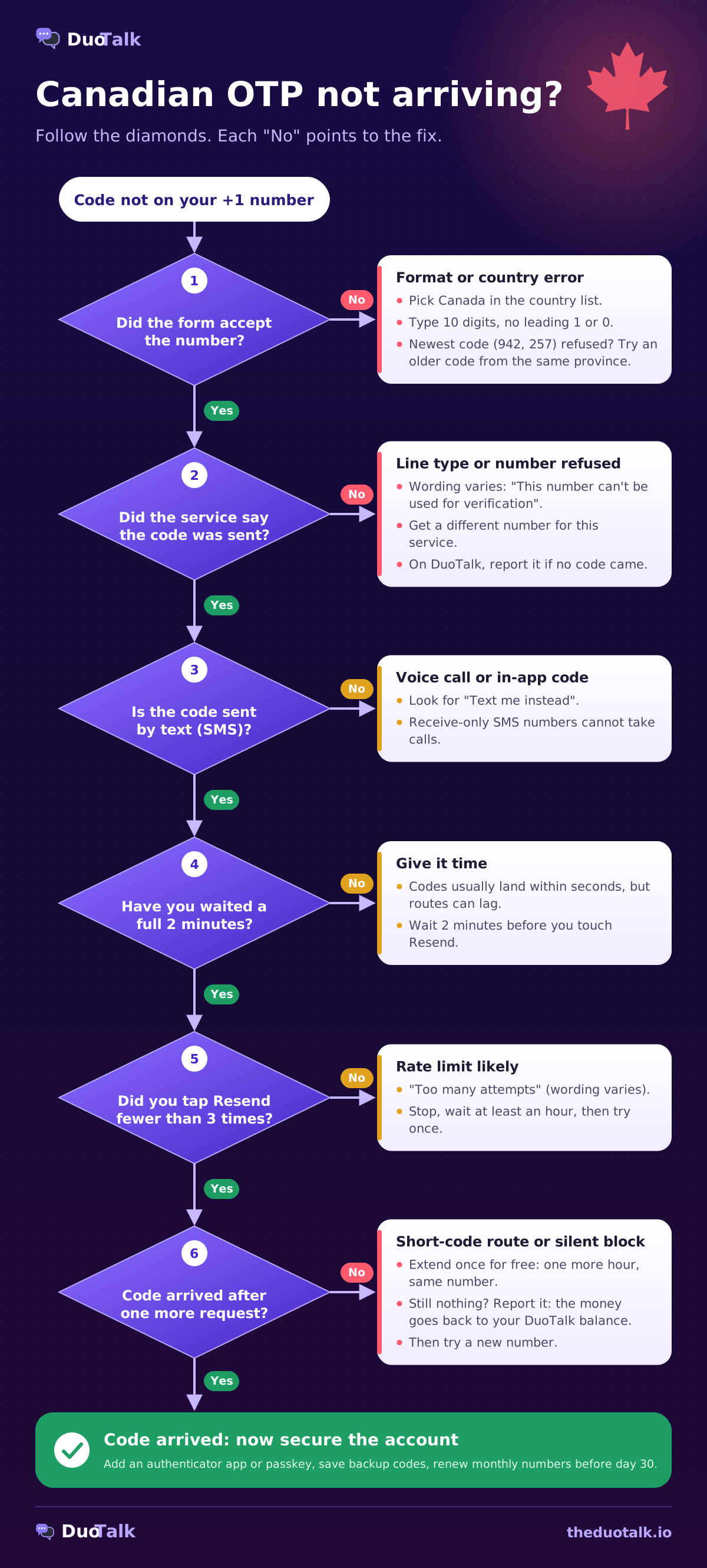
A Canadian OTP fails for one of six reasons: the number was typed or labelled wrong, the service rejected the line type or the number's history, the code was sent from a short code that did not reach the number, the service rate-limited you, the service sent a voice call instead of a text, or the service is checking something other than the number. Work through them in that order.
1. Format or country mismatch
The service says "Invalid phone number" or "Enter a valid Canadian number" before it sends anything. Check the country picker, remove any leading 1 or 0, and type digits only. If the area code is one of the newest (942 or 257), the app's own list may be outdated; a number from an older code in the same province usually passes.
2. Line-type or number-history rejection
The service says something like "This phone number cannot be used for verification" (wording varies), or it claims to send the code and nothing ever comes. Many services run a carrier lookup that labels a number as mobile, landline or VoIP, and some refuse anything that is not mobile. Others keep their own list of numbers that were used many times before. Neither is something you can fix by retrying. Get a different number for that service and, on DuoTalk, report the first one if no code came. Our guide to why a virtual number is not accepted covers the causes in depth, including the line-type check.
3. Short-code delivery in Canada
The service says the code was sent, but nothing arrives. Many services send OTPs from a short code, a 5 or 6 digit sender number instead of a full phone number. In Canada, short codes run through the Common Short Code program, which the Canadian Telecommunications Association administers for the wireless carriers, as described on txt.ca. A short code must be approved and provisioned on each participating network, and Canadian carriers block unapproved senders. If a service's short code is not set up for the network behind a number, its texts can fail silently. This is a common reason codes reach one Canadian number and not another. The fix is a different number, or asking the service for another channel.
4. Rate limits
You see "Too many attempts. Try again later." (wording varies) or codes simply stop. Services cap how many codes they send to one number, one device or one IP address in a short time. Stop requesting, wait at least an hour, then try once. Changing the number does not always help, because the limit may be on your device or connection.
5. Voice-only or app-only delivery
The service offers only "Call me", or it sends the code inside another app, such as a push prompt on a device already logged in. A receive-only SMS number cannot take a call. Look for a "Text me instead" link, or change the verification method in the account settings once you are signed in.
6. Checks that are not about the number
You get the code, enter it, and the service still blocks the sign-up or asks for more. The service may be checking your IP address, device, payment card or identity documents. A Canadian number cannot and should not get round those checks.
| What you see (wording varies) | Most likely cause | What to do |
|---|---|---|
| "Invalid phone number" | Wrong country or extra digit | Pick Canada, type 10 digits only |
| "Please enter a Canadian number" | US area code, or an outdated area-code list | Use a Canadian code; try an older code in the same province |
| "This number can't be used for verification" | Line-type or number-history rejection | Use a different number; report the first if no code came |
| "Code sent" but nothing arrives | Short-code delivery or silent rejection | Wait 2 minutes, request once more, then extend or report |
| "Too many attempts" | Rate limit | Stop, wait at least an hour, try once |
| Only "Call me" is offered | Voice-only delivery | Look for a text option; SMS-only numbers cannot take calls |
| Code accepted, sign-up still blocked | IP, device or identity check | Follow the service's rules; contact its support |
If you want the general version of this checklist, for your own SIM as well as virtual numbers, read not receiving verification codes.
Keeping your Canadian account safe after the code
Once the OTP is in, the safest move is to add a stronger sign-in method and stop depending on the text message. SMS codes are convenient, but they are the weakest common second factor, and the number you used may not be yours forever.
The Canadian Centre for Cyber Security puts it plainly in its guidance on deploying multi-factor authentication: consider SMS codes only for low-risk logins, because the codes are sent unencrypted and attackers increasingly intercept them through SIM swapping, phishing and social engineering. Its MFA guidance for individuals adds that attackers send texts made to look like the real service. The Canadian Anti-Fraud Centre describes how criminals who take over a phone number use "Forgot Password" and the texted codes to seize email, social and financial accounts.
A short checklist after any Canadian sign-up:
- Add an authenticator app or a passkey if the service offers one. Google's 2-Step Verification help notes that text and call codes "can be vulnerable to phone number-based hacks," and that authenticator apps work without mobile service.
- Save the backup codes the service gives you, offline.
- Add a recovery email you control.
- If you used a monthly number, put the renewal date in your calendar. Renew from your numbers list before the 30 days end; nothing renews automatically.
- If you used a temporary number for an account you now want to keep, change the phone number in the account settings to a number you will keep, while you are still signed in.
- Never type a code someone else asks you for. No real service calls or texts to ask you to read back a code.
Questions people also ask
How can I get a Canadian phone number for OTP verification?
You can get one by buying a Canadian virtual number online, using a Canadian SIM or eSIM, or installing a calling app with Canadian area codes. For a code you need today, a private virtual number from an SMS verification service is fastest: select Canada and your service on the provider's numbers page, enter the 10 digits on the service, and read the OTP in your inbox. Use a monthly number if you will log in again.
How do I know if a +1 number is Canadian or American?
Check the area code, the three digits after +1. Canadian codes include 416, 437 and 647 for Toronto, 514 and 438 for Montreal, 604 and 778 for British Columbia, and 403 and 780 for Alberta. For certainty, enter the first six digits in the Canadian Numbering Administrator's CO Code lookup, which returns the province and exchange area. Toll-free codes such as 800 do not show a country.
Can I use a US number for Canadian apps?
Sometimes. If the app's phone field accepts any +1 number and never asks for Canada specifically, a US number usually works. If the field is fixed to Canada, or you see an error asking for a Canadian number, the app checks the area code and a US number will be refused. In that case you need a number with a Canadian area code, ideally one you can keep.
Why am I not receiving OTP on my Canadian number?
The most common reasons are a format error, a service that blocked the line type, a short code that is not delivered to that network, or a rate limit from too many resend requests. Wait two minutes, check that Canada is selected and that you typed 10 digits, then request once more. If nothing arrives, use a different number instead of resending, or ask the service for another way to verify.
Can I receive Canadian SMS codes while outside Canada?
Yes. A Canadian virtual number receives texts on the provider's side and shows them in your online inbox, so it works from any country with an internet connection. A Canadian SIM receives SMS abroad only if roaming is on. Some services also compare your number's country with your IP address or device region, so a mismatch can trigger extra checks even when the code arrives.
Is a temporary Canadian number safe for WhatsApp or Telegram?
It is safe for privacy if the inbox is private, but it is a poor choice for accounts tied to your phone number. Messaging apps can ask for a new code when you change phones or reinstall, and a temporary number will have expired by then. Use a monthly Canadian number you renew, or your own SIM, and turn on the app's own PIN or two-step verification right after sign-up.
Is it legal to use a virtual Canadian phone number?
Yes, virtual numbers are an ordinary telecom product, and using one to protect your personal number is lawful in general. What matters is how you use it. Each service sets its own terms, some do not allow virtual numbers, and using any number for fraud, impersonation or getting round identity checks is not allowed. This is general information, not legal advice; for regulated accounts such as banking, use your own number.
Get a private Canadian number for your code on DuoTalk
If a service has asked for a Canadian number and you would rather not hand over your personal one, a private Canadian virtual number is the practical next step. On DuoTalk you choose the service and Canada, see live stock and live prices, and pick a temporary number for a single OTP or a monthly number for an account you will keep. Every code appears in your own inbox, never on a public page. If a temporary number gets no code, you extend once for free, and if it still fails you report it and the money returns to your balance. For the whole process in one place, see how DuoTalk works, and for what happens from purchase to expiry, the number lifecycle page.
Ready when you are: see live Canadian numbers and prices.
Sources
- Canadian Numbering Administrator: Canadian Geographic Area Code Relief History (updated 29 May 2026)
- Canadian Numbering Administrator: CO Code / Phone Number Lookup
- North American Numbering Plan Administrator (NANPA)
- txt.ca: Common Short Codes for consumers (Canadian Telecommunications Association)
- Canadian Centre for Cyber Security: Steps for effectively deploying multi-factor authentication (ITSAP.00.105)
- Canadian Centre for Cyber Security: Secure your accounts and devices with multi-factor authentication (ITSAP.30.030)
- Canadian Anti-Fraud Centre: SIM card swap
- Government of Canada: GCKey help
- Google Account Help: Turn on 2-Step Verification
- Chexy Help Centre: Why does Chexy require a Canadian phone number?
Last reviewed: November 2026