How to Get a Temporary US Phone Number for SMS Verification
A temporary US phone number gets you one +1 verification code without a US SIM. See the 60-minute flow, how +1 numbers work and what to do if no code comes.
By the DuoTalk team · Published 2026-11-07 · Updated 2026-11-11
A temporary US phone number is a +1 number you use for a short window, usually an hour or less, to receive one SMS verification code and then let go. It is the fastest way to answer a US sign-up form when you do not have a US SIM, when you are travelling, or when you would rather not give a new app your personal number. This guide covers the short-term route only: how the 60-minute window works, how a +1 number is built so forms accept it, which US services usually ask for +1, and what to do when the code does not arrive.
The short answer: To get a temporary US phone number, buy a one-time +1 number for the exact service that is asking, type the 10 digits with the form set to United States, and read the code in your private inbox within the 60-minute window. Use it only for accounts you will not need to log back into by SMS. For anything you will keep, use a monthly number or your own US line.
If you need the broad picture first (Google Voice, calling apps, US SIMs and monthly numbers compared), read the full US number guide. This post assumes you have already decided that one code, once, is all you need.
What a temporary US phone number is
A temporary US phone number is a real +1 number assigned to you for a fixed, short period so that a service can text you a one-time code. You read the SMS in an online inbox instead of on a SIM card, and when the window closes the number stops being yours.
Three details separate a useful temporary number from a useless one:
- It must be private. Only you should see the messages. A number listed on a public "free SMS" page shows your code to anyone who refreshes the page, which also means anyone can later ask for a password-reset code on the same account.
- It must be the right line type. Many large US apps check whether a number is mobile, VoIP, landline or toll-free before they send anything. A number that looks like an internet calling line is often refused at the form. That is the difference between VoIP and non-VoIP numbers, and it decides a lot of sign-ups.
- It must match the service. On DuoTalk, a short-term number receives SMS only from the one service you choose when you buy it. If you buy a number for Uber and type it into a Google form, the Google code will not show up.
How short is "temporary"?
On DuoTalk (theduotalk.io), a web app that gives you private virtual numbers to receive SMS online, a short-term number works like this:
| Stage | What happens |
|---|---|
| Purchase | The number is yours for 60 minutes |
| First code arrives | The number stays open 7 more minutes, enough for a second code if the service sends one |
| No code at all | You can extend once for free: another hour on the same number |
| Still nothing | Report it, and the money goes back to your DuoTalk balance |
Other providers use different windows, so read the timer first and request the code soon after you get the number.
What a temporary number cannot do
DuoTalk numbers receive SMS only. They cannot send texts and they cannot take calls, so the "Call me instead" option on a sign-up form will not work. And no provider can promise that a service will accept a number: a code can arrive and the service can still decide, then or later, that it does not want that number on the account.
When a temporary US number is the right choice
Use a temporary US number when the account is low stakes and you will never need a second SMS code for it. Do not use one for anything you need to recover, pay with or prove your identity on.
The test: "If this app texts me a login code in three months, will I care that I cannot read it?" If not, a one-time +1 number fits. If yes, you need a number you keep.
| Situation | Temporary US number? | Why |
|---|---|---|
| Trying a US-only app or free trial once | Yes | One code, no future logins by SMS |
| Claiming a one-off coupon or newsletter sign-up | Yes | Keeps your real number off marketing lists |
| Testing your own sign-up flow with a +1 number | Yes | You need a fresh number for one run |
| Joining a US forum or community you may leave | Usually yes | Add an email login and an authenticator if offered |
| A ride-hailing or delivery account you will use for a trip | Maybe | Fine for a short trip, but the app may re-verify later |
| A messaging account you will use every day | No | New devices trigger new codes; use a monthly number |
| Your main email account | No | The number becomes a recovery route |
| Banks, payment, crypto, tax or government sites | No | Use your own number in your name and follow the service's identity rules |
If you are unsure whether you will come back, pick the longer option. Losing access to an account because the number expired costs more than the difference in price. For the long-term route, the one-time vs monthly comparison walks through the trade-offs.
How a +1 number is built: area codes and formats
A US phone number has 10 digits after the country code +1: a 3-digit area code, a 3-digit exchange code and a 4-digit line number. Knowing these parts saves you from the most common form errors, and it explains why a temporary number from one city works fine for an app based in another.
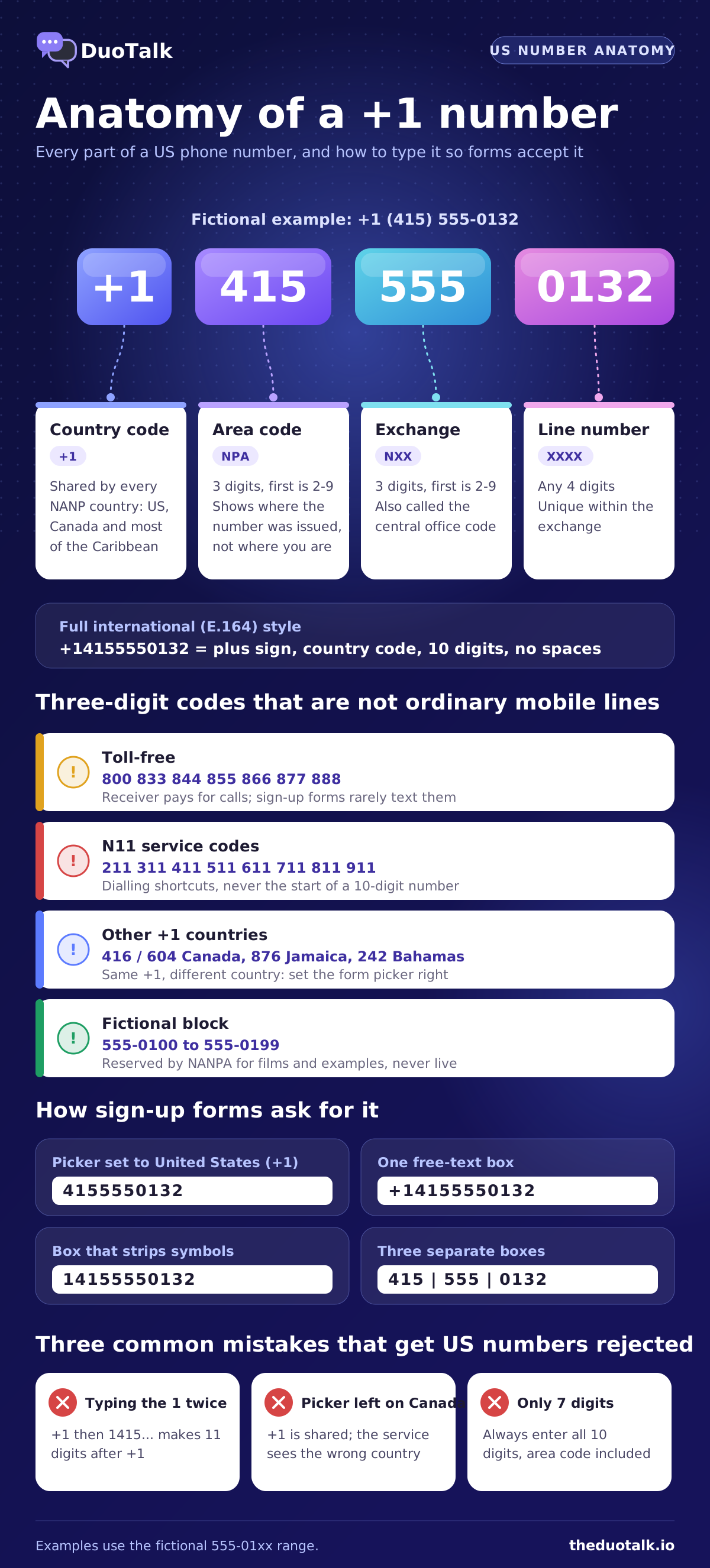
The four parts of a US number
Take the fictional number +1 (415) 555-0132:
| Part | Digits | Name in the numbering plan | Rule |
|---|---|---|---|
| +1 | 1 | Country code | Shared by every country in the North American Numbering Plan (NANP) |
| 415 | 3 | Area code (NPA) | First digit 2 to 9; codes ending in "11" are service codes, not area codes |
| 555 | 3 | Exchange or central office code (NXX) | First digit 2 to 9 |
| 0132 | 4 | Line number | Any four digits |
The NANP is managed by the North American Numbering Plan Administrator, and its format fits inside the international E.164 standard published by the ITU, which caps a full international number at 15 digits. A US number written in E.164 style looks like +14155550132: plus sign, country code, then the 10 digits with no spaces or brackets.
The 555-01xx block in that example is not a coincidence. NANPA keeps 555-0100 through 555-0199 reserved as fictitious, non-working numbers for films and advertising, which is why every example in this guide uses them.
Area codes that are not ordinary mobile lines
Some three-digit codes look like area codes but are not normal places to receive a sign-up code:
- Toll-free codes: 800, 833, 844, 855, 866, 877 and 888. The receiver pays for calls, and most sign-up forms will not text them.
- N11 service codes: 211, 311, 411, 511, 611, 711, 811 and 911. These are dialling shortcuts, never the start of a 10-digit number.
- Other +1 countries: Canada and most of the Caribbean also use +1. A number starting 416 or 604 is Canadian, 876 is Jamaica, 242 is the Bahamas. They look identical in a form, but a service that wants a US number specifically will treat them differently. If you need a Canadian number instead, our Canada phone number for OTP guide covers how to tell the two apart.
Does the area code matter for verification?
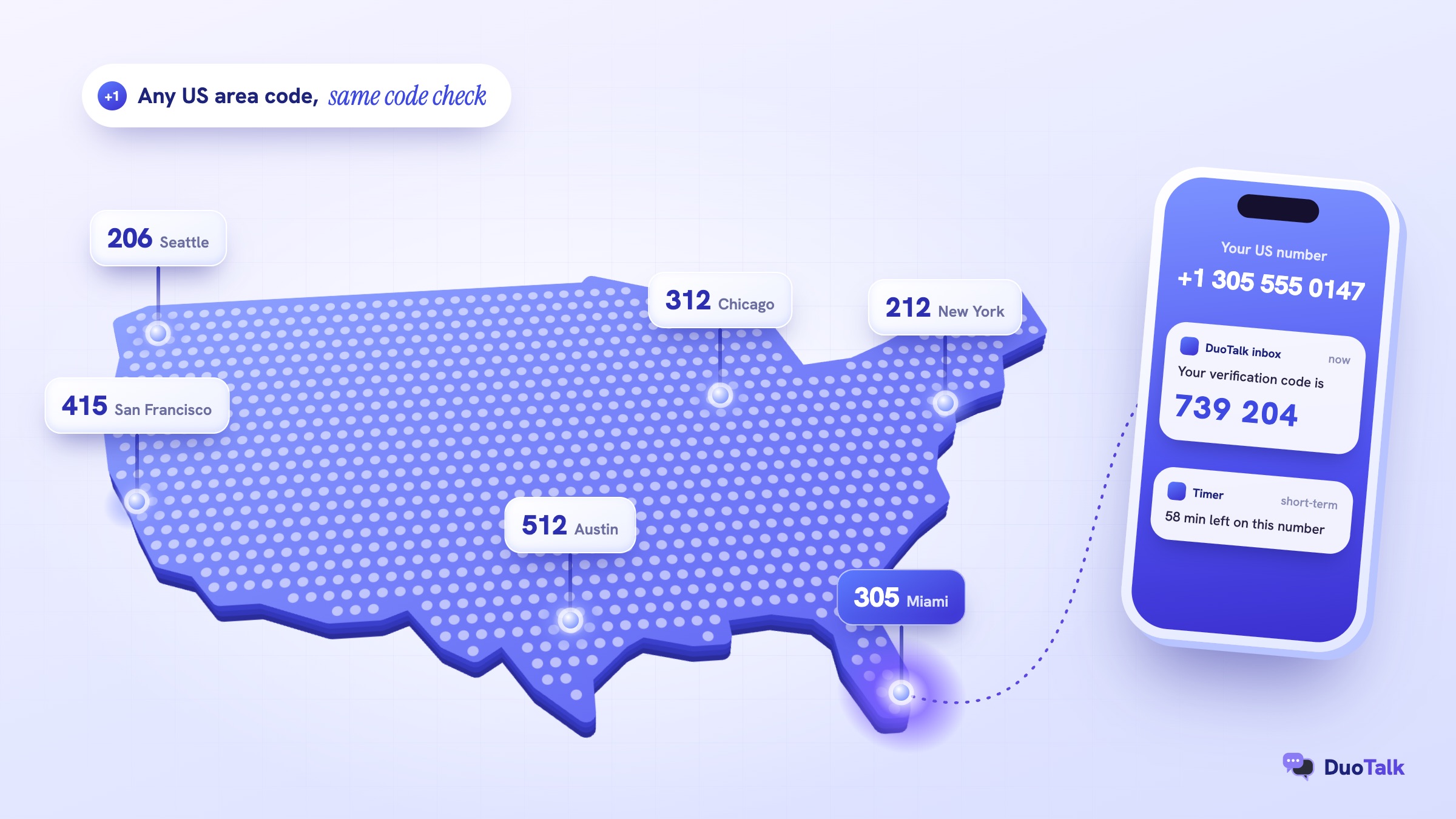
For verification, the area code almost never matters. Services check the country code and the line type, and sometimes the number's reputation, but they do not check whether a 305 number belongs to someone in Miami. People keep mobile numbers when they move, so an area code says where a number was first issued, not where its owner is.
On DuoTalk you can still pick an area code where one is in stock, or choose Any; for a one-time code, Any is quicker.
10-digit dialling and why forms want all 10 digits
Since October 24, 2021, callers in 82 US area codes have had to dial all 10 digits even for local calls, a change the FCC required so that the 988 crisis line would route correctly. For sign-up forms, the takeaway is simple: always enter the full 10 digits. Never shorten a US number to 7.
How forms ask for a +1 number
| The form shows | Type this | Example (fictional) |
|---|---|---|
| Country picker set to United States (+1) and one number box | 10 digits only | 4155550132 |
| One free-text box, no country picker | Plus sign and all 11 digits | +14155550132 |
| A box that strips symbols | 1 and 10 digits | 14155550132 |
| Three boxes | 415 / 555 / 0132 | 415 / 555 / 0132 |
The most frequent mistake is typing the leading 1 again after choosing +1 in the picker, which produces a 12-digit "+1 1415..." number that no carrier will deliver to. The second most frequent is leaving the picker on Canada or another +1 country because it happened to be the default.
US services that commonly ask for a +1 number
Most international apps accept numbers from many countries, but a group of US-first services either show only +1 at sign-up or behave better with a US number. A temporary number suits some of them and is the wrong tool for others.
| Category | Why +1 comes up | Temporary number suitable? |
|---|---|---|
| US-first social and community apps | Sign-up form defaults to or only offers +1 | Often, for an account you may not keep |
| AI tools and chat apps | Phone check to limit free-tier abuse; many reject VoIP | Sometimes; OpenAI says it does not accept landline, Google Voice or other VoIP numbers |
| Ride-hailing, delivery and travel apps | You may only need them for one trip | Yes for a short trip; expect re-checks on new devices |
| US retail and marketplace accounts | Order texts and account checks | Fine for a one-off order; use a kept number for an account you will reuse |
| Email providers | Anti-spam check at sign-up | Only if you add other recovery options at once |
| Banks, payment and money-transfer apps | Identity and fraud rules | No, use your own number in your name |
| Government sign-in services | Identity proofing | No. Login.gov, for example, requires a US-based number and refuses VoIP and most prepaid numbers for identity checks |
The more a service handles money or identity, the less sense a temporary phone number makes, and the more likely it is that using one breaks the service's rules. Follow each service's terms and identity requirements. A US number helps you receive a code; it does not make you a US resident and should never be used to get around a country restriction.
The services that reject VoIP lines are exactly the ones where a private, mobile-classified number matters. When you buy, choose the exact service name on the Numbers page, because stock and acceptance are tracked per service and country.
How to get a temporary US phone number: the 60-minute flow
Getting a temporary US number takes about five minutes: pick the service, buy a USA virtual phone number, paste it into the form, and read the code. The steps below follow DuoTalk's short-term number from purchase to the end of the window, with what you should be doing at each point on the clock.
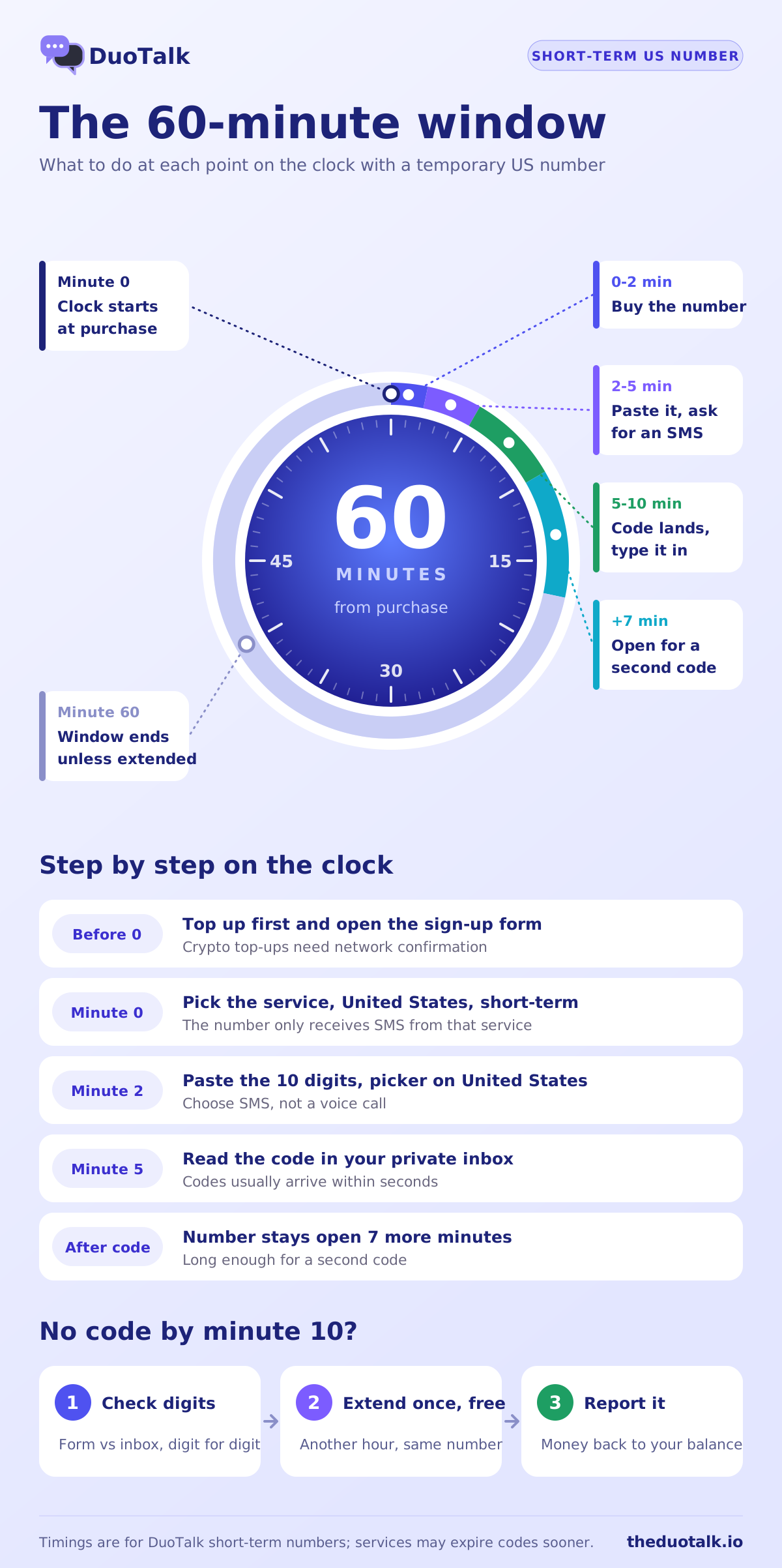
Before minute 0: get ready
Have three things ready before you buy, so the clock is not running while you search:
- The sign-up form of the service, already at the phone number step.
- Your DuoTalk balance. Top-ups are crypto only: USDT (TRC20 or BEP20), TRX, LTC, BTC or ETH. Balance is added automatically once the network confirms, which can take a few minutes for some coins, so top up first. The minimum top-up is $15, and the top-up help article lists each option.
- The exact service name you are verifying. A Google number will not receive a WhatsApp code.
Minute 0 to 2: buy the number
- Open the Numbers page and search for the service, for example Google, Telegram, Uber or ChatGPT.
- Choose United States as the country. Check the live stock and live price shown for that service.
- Choose short-term (one-time verification). Monthly numbers are a different product for accounts you keep.
- Confirm the purchase. The number appears in your list with a 60-minute timer.
Minute 2 to 5: enter the number and request the code
- Copy the number from DuoTalk instead of typing it, so no digit gets swapped.
- Set the form's country picker to United States (+1) and paste the 10 digits without the leading 1.
- Choose text message (SMS) if the form offers a choice. Do not choose a voice call.
- Press send once. Do not press "Resend" yet.
Minute 5 to 10: read the code
Codes usually arrive within seconds on tested routes. When yours lands in the DuoTalk inbox, type it into the form straight away; many services expire codes after 5 to 10 minutes on their side, whatever your number's timer says.
From the moment the first code arrives, the number stays open 7 more minutes. That covers the common case where a service sends a second code, for example one to confirm the number and another to confirm a password change or two-step setup during the same sign-up.
If minute 10 passes with nothing
- Check that the number in the form matches the number in DuoTalk digit for digit.
- Wait at least 60 seconds after the first request, then press "Resend" once. Many US services lock the resend button for 30 to 60 seconds, and repeated requests can trigger a temporary block on the account or device.
- Still nothing after a few minutes? Use the free extension: one more hour on the same number, once. The help article on extending and renewing shows where the button is.
- If the extension also produces no code, report the number. The money goes back to your DuoTalk balance, and you can try a fresh number.
After the code: finish the account properly
Before you close the tab, make the expired number harmless:
- Add an email address and, where offered, an authenticator app or passkey as the main sign-in method.
- Save any backup codes the service gives you.
Worked example: a one-off US sign-up
Lina lives in Berlin and wants to try a US recipe-sharing app that shows only +1 at sign-up and has no rules about where its users live. She tops up her DuoTalk balance in USDT the evening before. The next morning she opens the app's form, buys a short-term United States number for that app, and pastes the 10 digits with the picker on United States. The code arrives within seconds, she types it in, and the 7-minute follow-up window passes without a second code. She then adds her email as the login method and switches off "log in with phone". She will never need that number again, and the app never had her German mobile number.
Worked example: when the code does not come
Omar is setting up a US delivery app for a week-long work trip. He buys a number, pastes it, and nothing arrives after two minutes. He spots the problem: the form defaulted to Canada (+1) because his browser language is set to French. He switches the picker to United States, requests the code again after the 60-second lock, and it arrives. Had the code still not come, he would have used the free extension, then reported the number for a refund to his balance.
Using a temporary US number when you travel
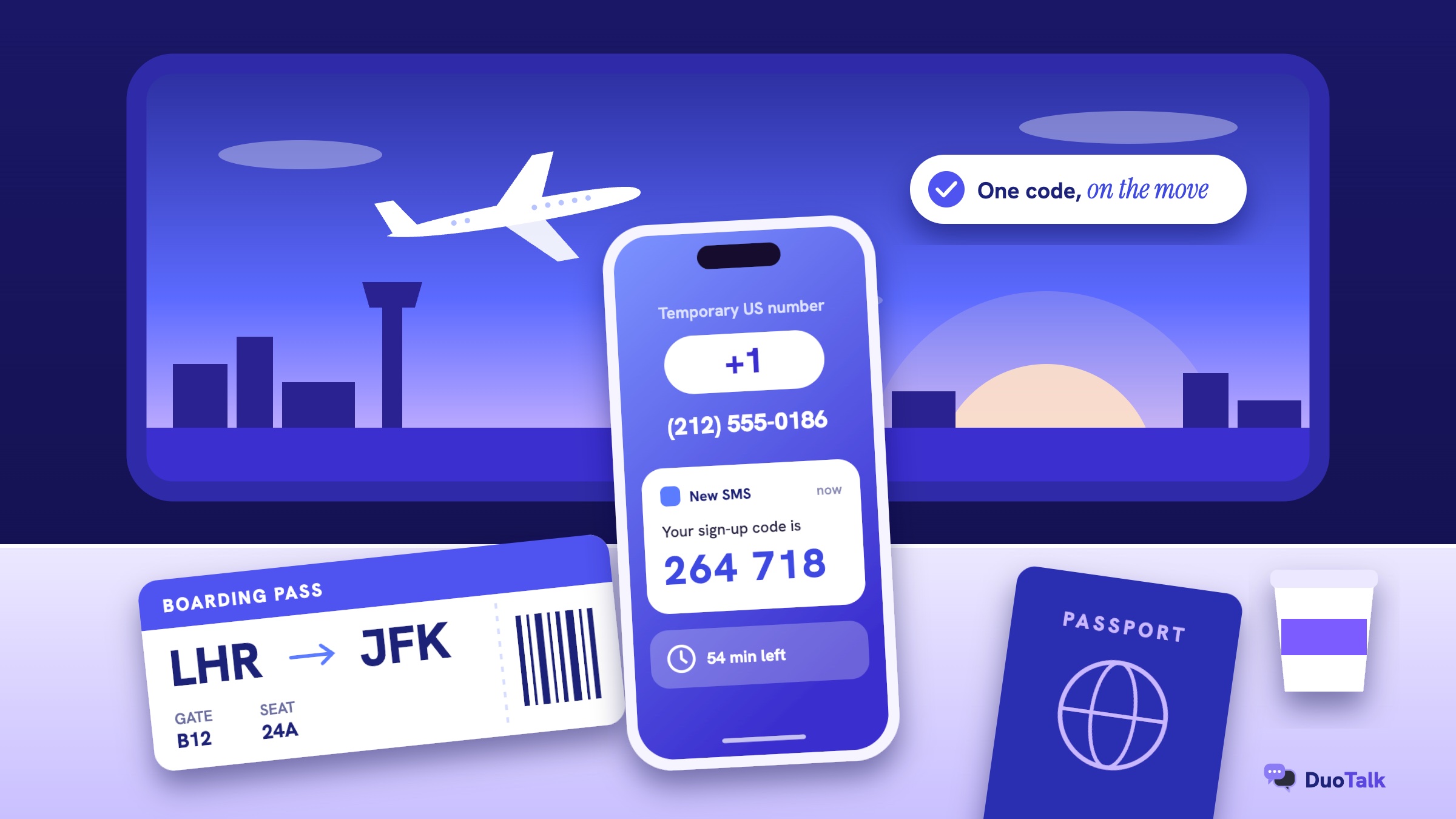
A temporary US number is most useful on a trip when you need one +1 code to activate a local app and your home SIM is off, roaming is expensive, or you do not want a travel app holding your personal number. Keep your home number for everything that already depends on it.
Before you fly
- Keep your home SIM's accounts safe. Your bank and email send codes to your own number. Check your carrier's roaming rules for receiving SMS abroad, and move key accounts to an authenticator app or passkey before you leave.
- Top up your DuoTalk balance at home, on a connection you trust, so you are not waiting for crypto confirmations at the gate.
- List the US apps you expect to need and mark each as one-time (a single sign-up) or ongoing (you will log in again during the trip). Ongoing apps on a long trip are better served by a monthly number or a US eSIM.
On arrival
Most travel needs are one-off: a transit app, a parking or scooter app, a venue's ticket app, a café Wi-Fi portal that texts a code. Each is a good fit for a 60-minute number. Buy the number when you are standing at the sign-up screen, not the night before, because the clock starts at purchase.
Staying for weeks? A prepaid US eSIM gives you data, calls and SMS on one line, and you can still use temporary numbers for apps you do not want tied to it.
Coming home
When the trip ends, open each app you signed up for and either delete the account or change the phone number to one you keep. A one-time number is gone after its window, and numbers are later reassigned. A 2021 Princeton study of number recycling found that 66% of the recycled carrier numbers it sampled were still tied to previous owners' accounts, which is exactly the risk you remove by tidying up.
Travel quick-check
| Need on the trip | Best fit |
|---|---|
| One code to activate a local app | Temporary US number |
| Several apps, all one-off | A temporary number for each, bought at the moment you need it |
| An app you will open daily for a month | Monthly US number or US eSIM |
| Calls to hotels or drivers | A US eSIM or your roaming plan; verification numbers cannot take calls |
| Codes for your bank at home | Your own SIM, or the bank's app-based approval |
Why US codes sometimes do not arrive
Most missed US codes come from four causes: the wrong service chosen at purchase, the wrong country in the form, the service refusing the number type, or rate limits after too many requests. Each has a quick fix.
US services send verification texts mainly from short codes, 5- or 6-digit numbers leased through the US Short Code Registry, or from ordinary 10-digit and toll-free sender numbers. If the service's own sending route has a problem, no number anywhere gets the code until it recovers.
| What you see | Likely cause | Fix |
|---|---|---|
| Form says the number is invalid | Leading 1 typed twice, or picker on the wrong +1 country | Picker on United States, 10 digits only |
| Form accepts the number, no SMS arrives | Number bought for a different service | Buy a number for the exact service name |
| "This number cannot be used" (wording varies) | Line-type or reputation check | Try a fresh number; some services refuse all virtual numbers |
| Code arrives, account later asks for a new one | Service re-verifies after sign-up | Expected with one-time numbers; use a monthly number for kept accounts |
| "Too many attempts, try later" | Rate limit on your account, device or IP | Wait 15 to 60 minutes before trying again |
| Form offers only "Call me" | Service wants a voice check | Receive-only numbers cannot take calls; use a different route the service offers |
| Nothing after the free extension | Route problem on that number | Report it; the money returns to your balance |
For the short-term flow, DuoTalk's own no SMS checklist walks through each check in order. If you want to understand what happens between the sender and the inbox, the explainer on temporary SMS numbers traces the route hop by hop.
After the 60 minutes: what happens to the number and your account
When a short-term number's window ends, you can no longer receive SMS on it, and the number can later be given to someone else. The account you created stays open, but any feature that relies on that phone number now points somewhere you cannot read.
That matters in three moments:
- Logging in on a new device. Some apps send an SMS code when you log in from a new phone or browser. If SMS is your only option, you are locked out.
- Password reset. If "send a code to my phone" is the only recovery path, it now goes to the number's next user.
- Security checks. A service may ask you to re-confirm your number after unusual activity.
You remove all three risks with a two-minute clean-up right after sign-up:
- Turn on an authenticator app, passkey or email login as the main method.
- Remove the temporary number from the account if the service allows it, or replace it with a number you keep.
- Store backup codes in your password manager.
DuoTalk's number lifecycle page explains what happens during access, when access ends and afterwards. If you realise mid-way that you need a kept number, switch to a monthly number. On DuoTalk nothing renews automatically, so you renew a monthly number from your numbers list before its 30 days end.
Temporary vs monthly US number at a glance
| Short-term (temporary) | Monthly | |
|---|---|---|
| How long | 60 minutes, plus 7 minutes after the first code | 30 days, renewed by you |
| Receives SMS from | Only the one service chosen at purchase | Any service |
| Best for | A single sign-up or test | Accounts you will log back into |
| If no code arrives | Extend once free, then report for a refund to balance | Refund on request within 48 hours if it never receives an SMS |
| Calls | No | No |
Safety rules for temporary US numbers
A temporary US number is a privacy tool, not a way around anyone's rules. Use it to keep your personal number out of databases, to separate a side project from your main identity, or to test, and keep it away from anything that needs to know who you really are.
- Never on financial or identity accounts. Banks, payment apps, crypto exchanges, tax and government portals expect a number in your name and may treat a temporary number as a fraud signal. Use your own number and follow the service's identity checks.
- Never to get around a ban or a country restriction. If a service is not offered where you live, a +1 number does not change that.
- Never for bulk accounts. One person, one account per service is the honest use.
- Never on public inbox sites for an account you care about. If the code is public, the account is public.
- Do not share codes. No real company will text you and ask you to read a verification code back to them. That is a takeover attempt.
Questions people also ask
How can I get a temporary US phone number for free?
Free temporary US numbers exist on public inbox websites, but every message on them is visible to anyone, and popular apps block most of those numbers. Free calling apps give you a private number, yet many need a US setup and their VoIP lines are often refused. For one code that only you can read, a paid one-time number is the safer choice, and on DuoTalk a number that receives no code, even after the free extension, can be reported for a refund to your balance.
Can I receive SMS online with a USA number from outside the US?
Yes. A virtual US number receives texts on a provider's system, and you read them in a browser or app from any country, with no US SIM or roaming. Choose the service and United States on the provider's numbers page, enter the 10 digits on the form, and the code appears in your inbox. Our guide on how to receive SMS online compares every route.
How long does a temporary US number last?
It depends on the provider. On DuoTalk, a short-term US number lasts 60 minutes from purchase, and once the first code arrives it stays open 7 more minutes for a second code. If no code arrives, you can extend once for free for another hour. Monthly numbers last 30 days and must be renewed by you before they end, because nothing renews automatically.
Can I use a temporary US number for WhatsApp or Telegram?
You can verify with one, but it is a poor fit for an account you will use daily. Both apps ask for a new code when you install them on another phone, and the number becomes your account identity. A one-time number suits a test account. For a messaging account you keep, use a monthly number or your own line, and turn on the app's two-step PIN.
Why does an app say my US number is not valid?
Usually it is a formatting or line-type problem. If you typed the leading 1 after picking +1, or left the picker on Canada, the form rejects the number. If the format is right and the app still refuses it, the app is likely checking the line type or the number's history and declining virtual or VoIP numbers. Try a fresh number for the exact service, or another verification method.
Is it legal to use a temporary US phone number?
Using a temporary number to protect your privacy is generally lawful, in the same way as using a second SIM. What matters is how you use it: breaking a service's terms, creating accounts in bulk, evading bans or passing identity checks with someone else's details can break rules or laws. Use temporary numbers for your own low-stakes accounts and your own number for anything financial or official.
Can I choose a specific US area code?
Often, yes. On DuoTalk you can pick a US area code when you press Get Number, where that area code is in stock, or choose Any. For verification the area code rarely matters, because services look at the +1 country code and the line type, not the city. If you need a particular area code for a business line that people call, a US carrier line or a calling app is the better tool.
Get a temporary US number on DuoTalk
When a US sign-up asks for +1 and you need just one code, DuoTalk gives you a private short-term United States number for that exact service, read in your own inbox and never on a public page. You get 60 minutes, 7 extra minutes after the first code, one free extension if nothing arrives, and a refund to your balance if it still fails.
Pick the service, check live US stock and live prices on the Numbers page, and finish your sign-up in a few minutes. If you are new to DuoTalk, the how it works page shows the whole process in one screen. And if you want to compare every way to receive SMS online, from public inboxes to eSIMs, start with the complete guide to how to receive codes online privately.
Sources
- NANPA: North American Numbering Plan Administrator
- NANPA: 555 line numbers (555-0100 to 555-0199 reserved as fictitious)
- ITU-T Recommendation E.164: The international public telecommunication numbering plan
- FCC consumer guide: Ten-digit dialing
- US Short Code Registry
- Login.gov Help: Phone numbers accepted for identity verification
- OpenAI Help Center: Can I use a premium number, landline, Google Voice, or other VoIP phone number?
- Princeton University, Lee and Narayanan: Security and privacy risks of number recycling (2021)
Last reviewed: November 2026