Temporary SMS Number: How It Works and When to Use It
How a temporary SMS number works: routing, short codes, sender IDs, number pools and recycling, lifetimes, and why some codes never arrive. Read before you buy.
By the DuoTalk team · Published 2026-11-15 · Updated 2026-11-15
A temporary SMS number is a real phone number that you use for a short, fixed time to receive text messages, usually a verification code, in an online inbox instead of on your own SIM. When an app sends the code, the message travels from the app's messaging platform through an aggregator and the mobile networks to the number, and the number's provider shows it to whoever holds the number at that moment. When the time is up, the number goes back to a pool and may later serve someone else. That loop explains why codes usually land in seconds, why some never arrive, and why a temporary number suits a one-off sign-up but not an account you want to keep.
The short answer: A temporary SMS number is a short-term number you rent to receive texts online. The code travels sender, messaging platform, aggregator, carrier network, then the number's provider, which shows it in your private inbox while you hold the number. Use one for one-off sign-ups, trials and testing; use a monthly or your own number for accounts you will need to log into or recover later.
This guide is the technical explainer. If you want the practical walk-through (which number to pick, how to enter it, what to do in the first two minutes), read our step-by-step guide to a temporary phone number for verification. For the bigger picture of every way to get codes without your own SIM, start with the guide on how to receive SMS online.
What is a temporary SMS number?
A temporary SMS number is a dialable mobile or virtual number that a provider assigns to you for a limited window, during which every SMS sent to it appears in an online inbox only you can read. After the window ends, you lose access and the number returns to the provider's pool.
Three attributes define it:
- Duration. Access is time-boxed. On DuoTalk a short-term number works for 60 minutes from purchase; elsewhere you will see windows from a few minutes to a few days. Monthly numbers, which last 30 days, sit at the other end of the scale.
- Direction. Most temporary numbers are receive-only. You read incoming texts; you do not send replies or take calls. DuoTalk numbers, for example, receive SMS only.
- Ownership. You never own the number. The carrier that holds the number range assigns it to the provider, and the provider assigns it to you for the window you paid for.
Temporary SMS number vs similar terms
People use several names for overlapping things. The differences matter, because each one fails in a different way.
| Term | What it usually means | Who can read the texts | How long it lasts | Typical problem |
|---|---|---|---|---|
| Temporary SMS number | A number rented for a short window to receive texts online | Only the current holder (on a private service) | Minutes to hours | Gone once the window ends |
| Short term virtual phone number | Same idea, stressed as non-SIM and short-lived | Only the holder | Usually 1 hour to a few days | Some apps refuse virtual line types |
| Public inbox number | A shared number whose texts are posted on an open web page | Anyone | No control | Codes exposed, number over-used |
| Burner number | A secondary number kept for weeks or months, often in an app with calls | The holder | Weeks to months | Often a VoIP line that apps reject |
| Dedicated (monthly) number | A number reserved for you for 30 days or more | Only the holder | 30 days, renewable | Costs more; must be renewed |
| Your own SIM or eSIM | A carrier line in your name | You | As long as you pay | Your real number is exposed |
What a temporary SMS number can and cannot do
It can receive standard SMS from apps and websites, including codes from long numbers and many alphanumeric sender names. It can usually receive a second code within its window if the service asks again.
It cannot do everything a SIM can:
- It cannot send SMS or reply to a code.
- It cannot take voice calls, so "Call me instead" options will not reach you.
- It cannot receive MMS pictures, and it may not receive texts from short codes in another country (more on this below).
- It cannot receive anything after the window ends, including password-reset codes for the account you just created.
How temporary SMS numbers work: the route of one code
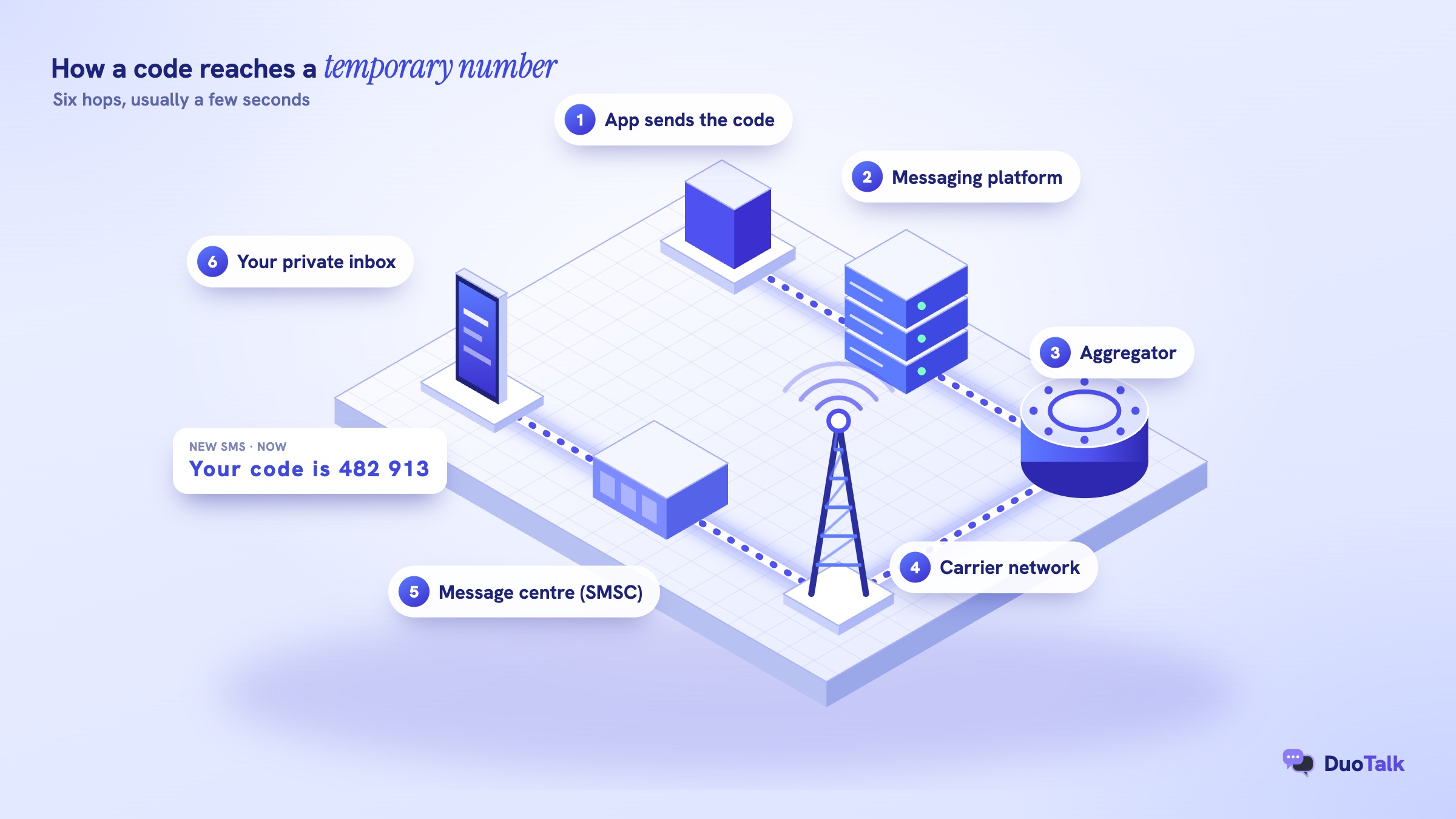
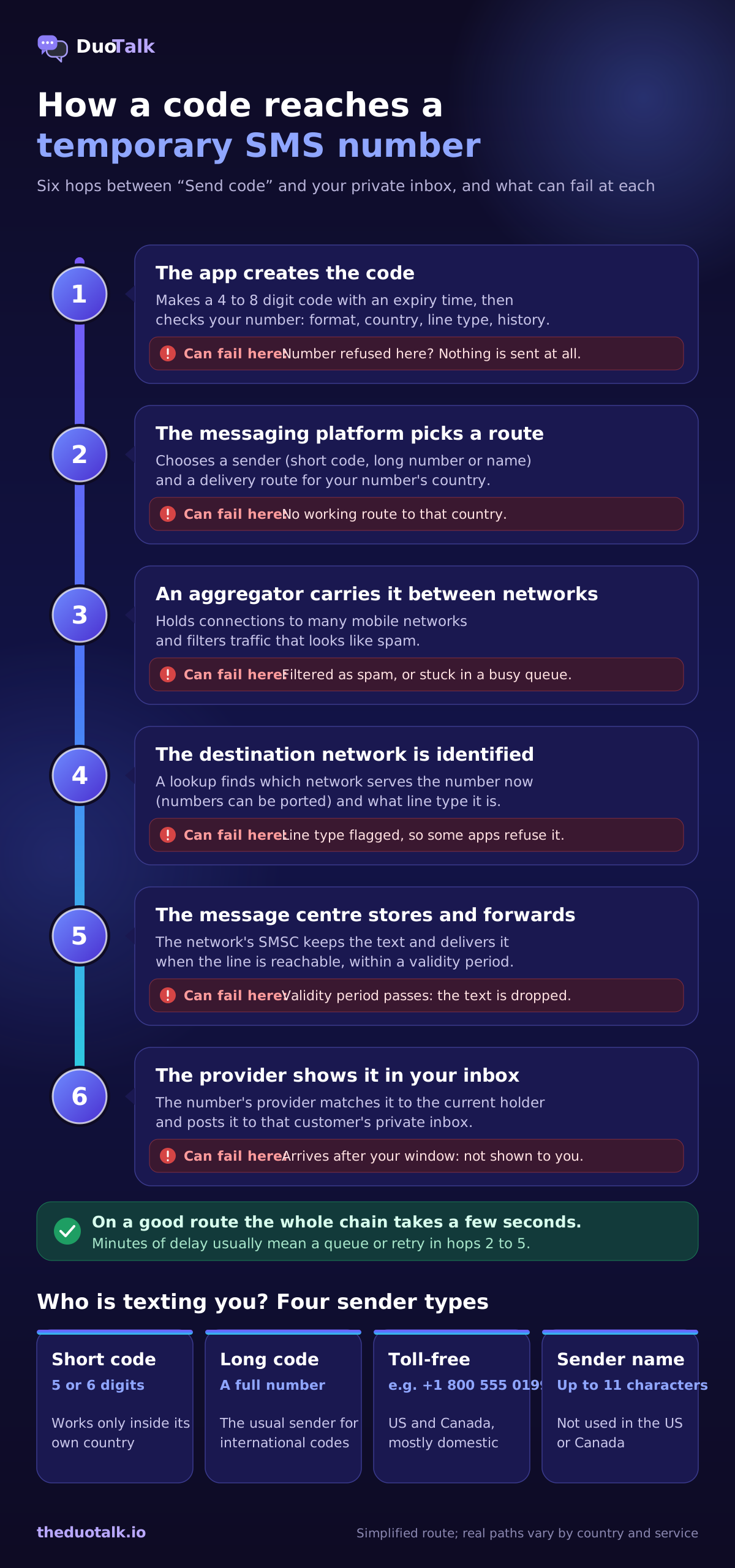
When you tap "Send code", the code passes through roughly six hops before it reaches a temporary number: the app, its messaging platform, an SMS aggregator or route, the network that holds the number, that network's message centre, and finally the provider's receiving system, which matches the text to your order and shows it in your inbox. Every hop can add delay or drop the message, which is why "the code never came" has more than one cause.
Here is the path in order, with what happens at each step.
- The app creates the code. The service generates a short code (usually 4 to 8 digits), stores it with an expiry time, and asks its messaging platform to send a text such as "Your code is 482913". At this step the app may also run checks on the number you typed: its format, its country, its line type and its history. If a check fails, nothing is sent at all.
- The messaging platform picks a route. Services hand the message to a messaging or verification platform, which chooses a sender identity (a short code, a long number or a sender name) and a route for the destination country. Depending on the platform, that route may run through one or more intermediaries or connect directly to a carrier's message centre.
- An aggregator carries it between networks. Aggregators sit between platforms and carriers. They hold the commercial connections to many mobile networks, filter traffic that looks like spam, and pass the message towards the destination network. A message for a UK number from a US app may cross two or three of these links.
- The destination network is identified. Before final delivery, the route has to know which network currently serves the number. Because numbers can be ported between carriers, this is a lookup, not a guess from the prefix. The same kind of lookup tells the sender whether the line is mobile, fixed or VoIP.
- The message centre stores and forwards. Each network has a Short Message Service Centre (SMSC). The SMSC accepts the text, stores it, and delivers it when the receiving end is reachable. The 3GPP standard for SMS (TS 23.040) lets the sender set a validity period: how long the message centre should keep trying before it gives up. Verification texts usually carry a short one, because a code that arrives an hour late is useless.
- The provider receives it and shows it to you. The number's provider receives the SMS on the line (either a real SIM in a gateway or a carrier-side virtual connection), checks which customer holds that number right now, and posts the message into that customer's private inbox. On a good route this whole chain takes a few seconds.
Where a temporary number actually lives
A temporary number has to terminate somewhere. There are two common setups, and they behave differently.
- SIM-backed numbers. The number belongs to a real mobile SIM sitting in a modem or gateway rack. To the sending network it looks exactly like an ordinary phone. Line-type lookups report it as mobile, and messages arrive through the normal mobile path.
- Carrier-hosted virtual numbers. The number is provisioned in the network but delivered to software over a data connection rather than to a physical SIM. Many of these show up as VoIP or "non-fixed VoIP" in a lookup, and some apps refuse them for that reason. Our explainer on virtual phone numbers without a SIM card covers the setup side in more detail.
When a code takes minutes rather than seconds, the delay is almost always a queue or retry in the middle of this chain, not the final inbox.
Short codes, long codes and sender IDs: who is texting you
The "from" field of a verification text is a sender identity, and its type decides whether a temporary number in a given country can receive it. There are four main types: short codes, ordinary long numbers, toll-free numbers and alphanumeric sender names.
| Sender type | What you see | Where it is used | Reachable from abroad? | What it means for a temporary number |
|---|---|---|---|---|
| Short code | 5 or 6 digits, e.g. 12345 | US, Canada, UK and many other countries, each with its own short codes | No, a short code works only inside its own country's networks | A foreign temporary number cannot receive another country's short code |
| Long code (standard number) | A full number, e.g. +1 213 555 0123 or +44 7700 900123 | Worldwide; in the US, registered business use is called 10DLC | Yes | The most common sender for international codes |
| Toll-free number | e.g. +1 800 555 0199 | US and Canada | Mostly domestic | Usually only reaches local numbers |
| Alphanumeric sender ID | A name, up to 11 characters, e.g. "VERIFY" | Most of Europe, Asia and Africa; not supported in the US or Canada | Depends on the destination country's rules | Arrives as a name; may be filtered if the name is not registered |
A few practical points follow from the table.
- Short codes are national. A US short code is reachable only on US networks. If a service tries to text a short code to a non-US number, the message has nowhere to go. Good services switch to a long number or a sender name for international numbers, but not all do. The official US short code registry, usshortcodes.com, run for the US wireless industry, lists who holds each code.
- US and Canadian rules are strict. In the US, the wireless industry body CTIA publishes Messaging Principles and Best Practices that carriers apply to business texting: short codes, registered long codes (10DLC) and verified toll-free numbers. Traffic that skips those routes is more likely to be filtered.
- Sender names are being policed. Several regulators now run sender ID registers to fight scam texts that pretend to be banks or delivery firms. Ireland's ComReg, for example, announced that from 3 July 2025 texts from unregistered sender IDs would be marked "Likely Scam", with blocking to follow. A legitimate service that has not registered its name in a given country may see its codes relabelled or blocked there.
The upshot: the country of your number decides which sender types the service can use to reach you, which is why one service can deliver instantly to one country's numbers and slowly or never to another's.
Number pools, recycling and lifetimes
Temporary numbers come from pools: groups of numbers a provider holds and lends out one customer at a time. Because the supply of numbers is finite, every pool recycles. A number you used last month may be someone else's today, and a number you get today was almost certainly someone else's before. This is normal across the whole phone industry, not only for temporary numbers.
What a number pool is
A pool is a set of numbers for one country (and often one network) that a provider can assign on demand. When you order a temporary number, the provider takes a free number from the pool, links it to your order for the paid window, and frees it again afterwards. Pools are why stock and prices change by country and service: when demand for a service in one country is high, fewer suitable numbers are free.
Why numbers are recycled
Carriers cannot issue new numbers forever. Number ranges are allocated by national regulators, and disconnected numbers are reissued after a rest period. In the US, federal rules (47 CFR 52.15) set an "aging" interval: a disconnected residential number must rest at least 45 days, and no more than 90, before it is assigned again. The FCC also runs a Reassigned Numbers Database so callers can check whether a number has changed hands.
Recycling has a known security side. Researchers at Princeton sampled 259 numbers available to new customers at two major US carriers and found that 171 of them, about 66 percent, were still linked to a previous owner's account on at least one popular website (Lee and Narayanan, eCrime 2021). The same risk applies in reverse to temporary numbers: if you leave an account linked to a number you no longer hold, a later holder could receive its codes.
What recycling means for you, in practice
- "This number is already in use." If a previous holder registered the same service with the number and never removed it, the service may refuse it or ask you to log in instead. Try a different number.
- Recovery codes go to the next holder. This is the real risk. If you plan to keep an account, move it to a number you control before your window ends.
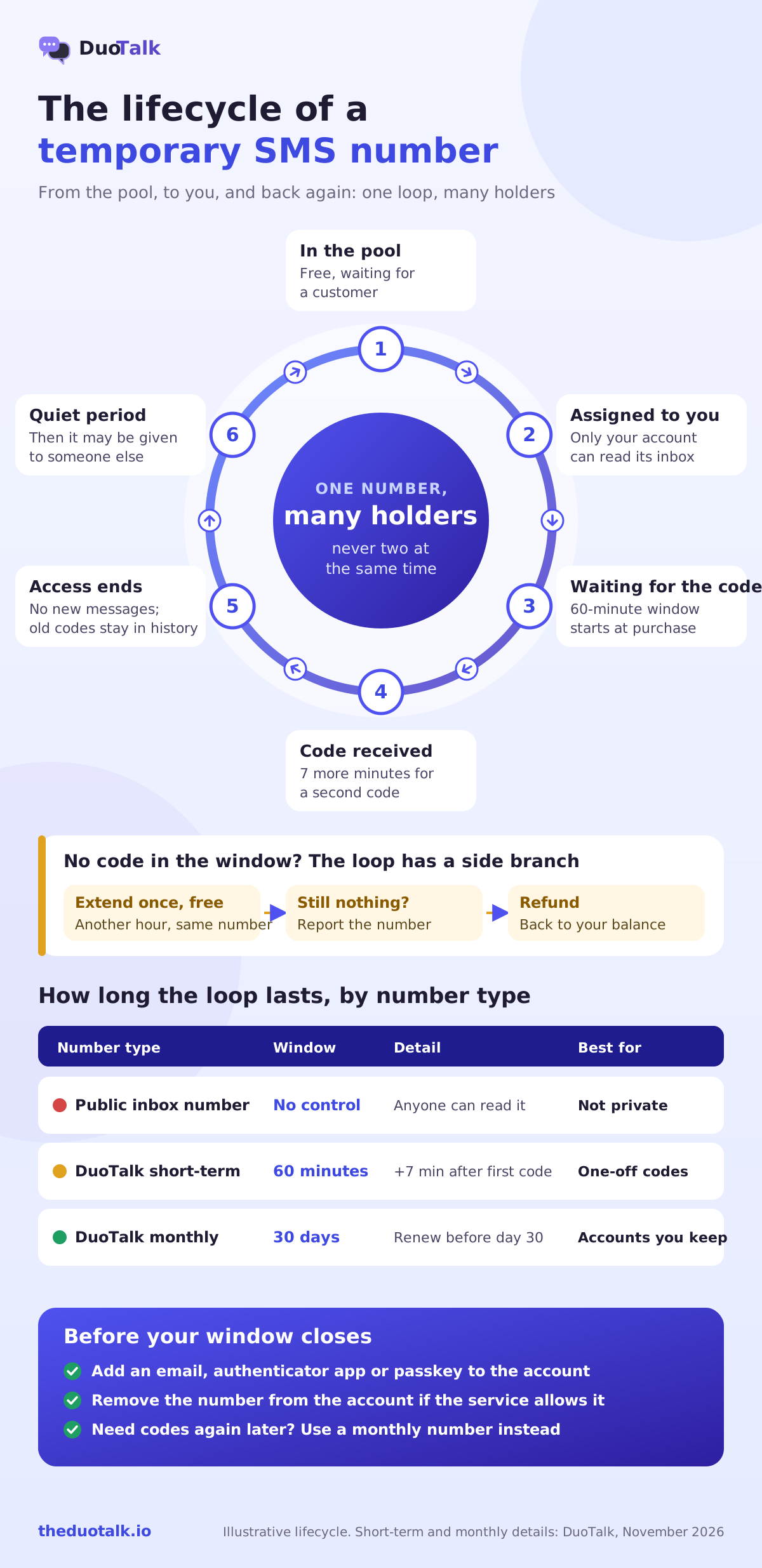
DuoTalk's number lifecycle page states the rule plainly: during access the number and its inbox belong to your account alone, nobody else is assigned the number while your access is active, and after access ends a number may be given to someone else after a quiet period.
Lifetimes: how long a temporary number lasts
The lifetime is the single biggest difference between products, so check it before you pay.
| Number type | Typical window | After the first code | If no code arrives | After the window |
|---|---|---|---|---|
| Public inbox number | Uncontrolled; may vanish any day | Anyone can read it | Nothing you can do | Stays public |
| DuoTalk short-term number | 60 minutes from purchase | Stays open 7 more minutes for a second code | Extend once free for another hour; then report for a refund to your balance | Access ends; cannot be recovered |
| DuoTalk monthly number | 30 days | Keeps receiving from any service | Refund on request within 48 hours if it never received an SMS | Renew before day 30 or lose it |
Why some codes never arrive on a temporary number
When a code does not arrive, it failed at one of three places: the service decided not to send it, the route lost or filtered it, or it arrived after the code or the number had expired. Knowing which one helps you choose the right fix, instead of tapping "Resend" until the service locks you out.
1. The service never sent it
This is the most common case, and it is invisible: the form says "Code sent" or simply waits, but no text ever leaves the service. Reasons include:
- Line-type checks. The service looked up the number, saw a line type it does not accept (often VoIP), and quietly skipped sending. Some services show an error instead; wording varies, for example "This phone number cannot be used for verification". Our guide to why a virtual number is not accepted lists the usual causes and fixes.
- Number reputation. Numbers that many people have used on the same service build a history. Services score that history and may refuse a number with a long record.
- Rate limits. Too many requests from one number, device or network in a short time trigger a cooldown, which can last minutes or hours.
- Risk scoring. A new device, a VPN or a country mismatch can make the service hold the text or switch to another check.
2. The route lost or filtered it
- No route to that country. The service's messaging platform may not have a working route to the number's country, or it tries a short code that cannot reach a foreign number.
- Filtering. Aggregators and carriers filter traffic that looks like spam. Legitimate verification texts get caught now and then, especially from unregistered sender names.
- Congestion. A busy route queues messages; if the wait outlasts the validity period, the text is dropped.
3. It arrived too late
- The code expired. Many services expire codes after 5 to 10 minutes. A late text still arrives, but the code no longer works.
- Only the newest code works. If you requested twice, the first code is usually void. Always enter the latest one.
- The number's window closed. A text that arrives after your access ends is not shown to you.
Symptom, likely hop, fix
| What you see | Most likely hop | What to do |
|---|---|---|
| Error on submit ("number not supported", "invalid number", wording varies) | The service's own checks | Try a different number or country; the number type may be the problem |
| "Code sent" but nothing after 2 to 3 minutes | Service skipped sending, or route failed | Wait once, request once more, then try another number |
| Code arrives after several minutes and is rejected as expired | Route congestion | Request a fresh code and enter it immediately |
| "This number is already registered" | Recycled number with an existing account | Use a different number |
| Codes work on a US number but not on another country's | Short code or route limits | Use a number from the service's home country |
| Second code never comes | Rate limit, or your window closed | Wait for the cooldown; check your timer |
On DuoTalk, if no code arrives in the 60 minutes you can extend once for free for another hour on the same number, and if it still fails you report it and an approved refund goes back to your balance. The help article No SMS arrived? What now? has the exact steps. For causes that also affect personal SIM cards (carrier blocks, roaming, phone filters), see not receiving verification codes: 10 fixes.
A worked example: one code, two outcomes
Say you sign up for a note-taking app that is popular in the US and sends codes from a US short code at home and from a long number abroad.
- Attempt A, US number. You get a short-term US number, enter it with +1, and tap "Send code" once. The app sends from its short code, the route is local, and the six-digit code appears in your inbox about ten seconds later.
- Attempt B, number from a country the app rarely serves. The app accepts the number, but its platform has no tuned route there. The text sits in a queue for six minutes, arrives, and the code has already expired. Requesting again works, because the route is now warm, but the delay could repeat.
The lesson: match the number's country to where the service normally sends, so its route is busy and well tested.
When to use a temporary SMS number (and when not to)
Use a temporary SMS number when you need one code, once, for an account you will not need to recover by SMS. Do not use one for anything you will log into again from a new device, anything that holds money, or anything where SMS is the only way back in.
Good uses
- One-off sign-ups and trials. A newsletter gate, a coupon, a free trial you will cancel, a Wi-Fi portal.
- Keeping your real number private. Marketplaces, forums and apps that ask for a phone number but do not need it long term.
- Testing. Checking a sign-up flow with a fresh number each run.
- Travel. Finishing a sign-up when your home SIM is off.
Poor uses
- Accounts you will keep. Logins on a new phone often trigger a fresh SMS code. Choose a monthly number, and see our comparison of disposable vs dedicated phone numbers for the trade-offs.
- Banking, payments and crypto. These services run identity checks. Follow their rules in full and use a number you will keep, such as your own SIM or a monthly number where the service allows it.
- Two-factor authentication. NIST's digital identity guidelines (SP 800-63B-4) treat codes sent over the phone network as a "restricted" authenticator, and a number you hold for an hour is the weakest version of that. Use an authenticator app or passkey for 2FA.
- Anything against a service's rules. A temporary number is a privacy tool. It is not a way to create accounts in bulk or to return after a ban.
Decision rule: if you are not sure whether the service will text you again, assume it will and choose a monthly number.
How to use a temporary SMS number well
A short routine prevents most failures: open the sign-up form first, buy a temporary phone number for the exact service and country, enter it in full international format, request the code once, and secure the account with another recovery method before the window closes. The steps below are the short version; the full walk-through is in our temporary phone number for verification guide.
- Pick the service and country first. Choose a country where the service is commonly used, so its sending route is well tested. On DuoTalk you can see live numbers by service and country before you sign in.
- Buy the number when you are ready. The short-term window starts at purchase. Have the sign-up page open and your details ready.
- Enter the number exactly. Select the matching country in the form's dropdown, then paste the national part without an extra leading zero. A +44 number typed under +1 will never receive anything.
- Request the code once. Wait a full two minutes before asking again. Repeated requests trigger rate limits and void earlier codes.
- Copy the newest code straight away. Codes often expire within minutes.
- Add a second recovery method. Add an email, authenticator app or passkey before the window closes, and unlink the number if the service allows it.
If you want the process without any SIM at all, including eSIM and authenticator alternatives, our guide on how to receive OTP without a SIM card compares the methods.
Private vs public: the one choice that matters most
Every point above assumes a private number. On a public inbox site, the same route delivers your code to an open web page that anyone can read and use first. A University of Florida study of public SMS gateways, presented at IEEE Security and Privacy 2016, also found services sending sensitive data in plain text to these numbers (Reaves et al., 2016).
Temporary SMS numbers on DuoTalk
DuoTalk (theduotalk.io) is a web app that gives you a private virtual phone number to receive SMS online for verification codes, so you do not hand out your personal number. It offers both ends of the lifetime scale: short-term numbers for a single code, and monthly numbers for accounts you keep.
How the two number types behave
| Short-term number | Monthly number | |
|---|---|---|
| Window | 60 minutes from purchase | 30 days |
| After the first code | 7 more minutes for a second code | Keeps receiving |
| Which services it receives from | Only the service you chose at purchase | Any service |
| If no SMS arrives | Extend once free for another hour, then report; approved refund to balance | Refund on request within 48 hours if it never receives an SMS |
| Renewal | Paid renewal for another hour while still available; never after its end date | Nothing renews automatically; renew from your numbers list before day 30 |
| Calls and sending | Receive SMS only | Receive SMS only |
| Availability | Many countries, changes with stock | Some countries only |
What to expect
- Live stock and prices. The Numbers page shows which services and countries have numbers right now and what they cost. Prices change with stock, so check live prices there rather than relying on a list.
- Speed. On tested routes, codes usually arrive within seconds.
- Honesty about acceptance. Receiving a code never guarantees the service will accept the number. Services change their rules, and a service can still refuse a number after sending a code.
- Payment. Top up your balance with crypto (USDT on TRC20 or BEP20, TRX, LTC, BTC or ETH); no fees or tax are added at checkout.
Questions people also ask
How do temporary SMS numbers work?
A temporary SMS number is a real number a provider lends you for a fixed window. When a service sends a code, the text goes from the service's messaging platform through an aggregator and the mobile networks to the number. The provider receives it on that line, checks which customer holds the number right now, and shows the message in that customer's private inbox. When the window ends, the number returns to the provider's pool.
How long does a temporary phone number last?
It depends on the provider and the product. Public inbox numbers have no fixed lifetime and can vanish any day. Paid short-term numbers usually last minutes to hours; on DuoTalk a short-term number works for 60 minutes from purchase and stays open 7 more minutes after the first code. Monthly numbers last 30 days and can be renewed before they end. Once access ends, you cannot read new texts sent to the number.
Can a temporary number receive codes from short codes?
Only from short codes in its own country. A short code, such as a 5 or 6 digit US sender, works only inside that country's mobile networks, so a temporary number from another country cannot receive it. Most international services switch to a long number or a sender name for foreign numbers, but some do not. If codes from a service never arrive, try a number from the service's home country.
Why am I not receiving SMS on my temporary number?
Usually the service never sent the text. Many apps check the number's line type, history and country first, and skip sending if they do not like the result. Other causes are rate limits after repeated requests, routes that do not reach that country, spam filtering, and codes arriving after they expire. Request the code once, wait two minutes, then try a different number or country rather than resending repeatedly.
Are temporary numbers recycled?
Yes. Phone numbers are a finite resource, so every provider and carrier reuses them. A temporary number goes back into a pool after your window ends and may be given to someone else later. That is why you should add an email, authenticator app or passkey to any account before your window closes, and remove the number from the account if the service allows it, so a later holder cannot receive its codes.
Can I get the same temporary number again?
Usually not. A short-term number is released when your window ends, and DuoTalk short-term numbers cannot be recovered after access ends. If you know you will need the same number again, for a re-login, a password reset or a security check, buy a monthly number instead, keep it renewed, and move the account to another number before you stop renewing.
Sources
- 3GPP TS 23.040: Technical realization of the Short Message Service (SMS)
- CTIA: Messaging Principles and Best Practices (May 2023)
- US Short Code Registry (usshortcodes.com)
- ComReg: From 3 July 2025 unregistered SMS Sender IDs to be modified to "Likely Scam"
- 47 CFR 52.15: Central office code administration (aging of disconnected numbers), eCFR
- FCC: Reassigned Numbers Database
- Lee and Narayanan, Princeton University: Security and Privacy Risks of Number Recycling at Mobile Carriers in the United States (eCrime 2021)
- Reaves et al., Sending Out an SMS: Characterizing the Security of the SMS Ecosystem with Public Gateways (IEEE S&P 2016)
- NIST SP 800-63B-4: Digital Identity Guidelines, Authentication and Authenticator Management
Last reviewed: November 2026