Disposable vs Dedicated Phone Numbers: Which Should You Choose?
Disposable vs dedicated phone number: one is for a single code, the other for an account you keep. How each works, recycling, recovery and which to pick.
By the DuoTalk team · Published 2026-11-13 · Updated 2026-11-13
Disposable vs dedicated phone number: the real difference is how long the number stays yours. A disposable phone number is a number you use once, usually to receive a single verification code, and then let go. A dedicated phone number is a number reserved for you that you keep, so the same account can text you again next week or next year. The choice between them is not about which is "better"; it is about one question: will this account ever need to send a code to this number again?
That question matters more than most people expect. Sign-up is only the first code. Logins on a new phone, password resets and two-factor prompts all come later, and they go to whatever number is on file. This guide explains how each type works, what really happens when a disposable number expires or gets recycled, which accounts need which type, and how to switch safely if you picked the wrong one.
The short answer: Use a disposable phone number for a one-off sign-up you will never need to verify again, such as a trial, a forum or a test account. Use a dedicated number (a monthly virtual number, or a SIM in your name) for any account you will log into again, because later login, recovery and 2FA codes go to the number on file, and a disposable number is gone within the hour.
What is a disposable phone number?
A disposable phone number is a temporary phone number that receives SMS for a short window, often minutes to an hour, and is not meant to stay linked to you. People also call it a burner number, a throwaway number or a one-time number. Its job is to get one verification code without exposing your personal number.
The term covers several quite different things, and the differences decide how safe it is:
- One-time verification numbers. A private number you buy for a single service and country. You read the code in your own inbox, and the number closes after a fixed time. On DuoTalk this is the short-term number: 60 minutes from purchase.
- Burner app numbers. Second-line apps that give you a number for days or weeks, then let you "burn" it and pick a new one. They often support calls and texts, and many are VoIP numbers.
- Free public inbox numbers. Websites that list numbers anyone can open. Every message to that number shows on a public page. These are disposable in the worst sense: shared, and readable by strangers.
- Prepaid burner SIMs. A cheap physical SIM bought for a short period. In many countries this now requires ID at purchase, so it is less anonymous than the name suggests.
Disposable does not have to mean public
A disposable number can be private. "Disposable" describes how long you use the number. "Public" describes who can read it. A one-time number from a paid service is disposable but private: only you see the code. A free inbox site is disposable and public: anyone who opens the page sees the code at the same moment you do, and can use it if they are faster.
This is the single most common confusion in searches for a disposable number for OTP verification. The risk people associate with "disposable numbers" mostly belongs to public inboxes. If you want the full comparison of free and paid options, read our guide on free vs paid SMS verification.
What a disposable number is good at
- Keeping your real number off a site you do not fully trust.
- Avoiding marketing texts and spam calls after a one-off sign-up.
- Testing your own app's sign-up flow without using staff phones.
- Grabbing a code while travelling, when your home SIM is off.
What it is bad at is everything that happens after the first code.
What is a dedicated phone number?
A dedicated phone number is a number assigned to one customer only, for an ongoing period, so messages to it reach the same person every time. In the verification world, "dedicated" means two things at once: nobody else can read it, and it stays yours long enough to receive later codes.
You will meet three kinds:
- Your carrier SIM or eSIM. The strongest form of dedicated number. It is in your name, works as long as you keep the plan, and in most countries you can port it to another carrier.
- A monthly virtual number. A number reserved for you for 30 days at a time, read online, renewable. On DuoTalk, monthly numbers receive SMS from any service, which matters if you link several accounts to one number.
- A business dedicated number. In business messaging, "dedicated number" means a number only your company sends from, as opposed to a shared sender. That meaning is about sending marketing or alerts, not receiving codes, so ignore it when you are signing up for an account.
Dedicated is not the same as permanent
A monthly virtual number is dedicated while it is active. When you stop renewing it, it goes back to the provider, and like every number it can eventually be given to someone else. Only a SIM plan you keep paying for, and can port, comes close to permanent. That is why banks and government services should stay on your own SIM (more on that below).
Three questions that describe any number
Before comparing types, it helps to see that every number has three separate properties. Most bad choices come from mixing them up.
| Question | Possible answers | Why it matters |
|---|---|---|
| How long is it mine? | Minutes, days, 30 days renewable, years | Decides whether later login and recovery codes reach you |
| Who can read the texts? | Only me, or anyone with the link | Decides whether a stranger can use your code |
| What line type does it look like? | Mobile, landline, VoIP or virtual | Decides whether the service accepts the number at all |
A disposable number answers "minutes" to the first question. A dedicated number answers "30 days or more". Both can be private, and both can be mobile or VoIP, so you still need to check the other two answers.
Disposable vs dedicated phone number: side-by-side comparison
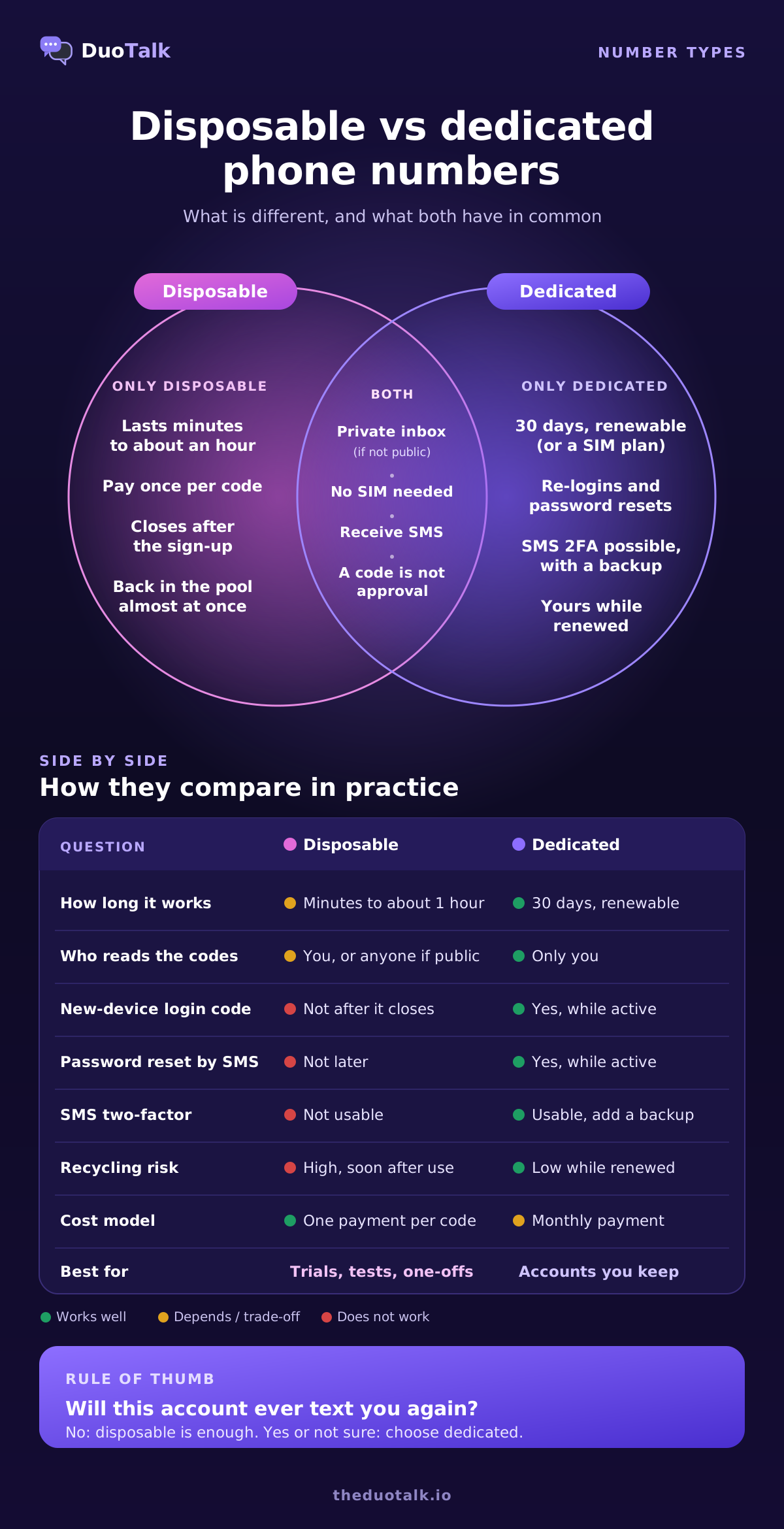
The difference between a disposable and a dedicated phone number is lifetime: a disposable number covers one code, a dedicated number covers every code an account sends while you keep it. Everything else in the table below follows from that.
| Disposable (one-time) number | Dedicated (kept) number | |
|---|---|---|
| How long it works | Minutes to about an hour (DuoTalk: 60 minutes, plus 7 more after the first code) | 30 days renewable (monthly virtual) or as long as you pay (SIM) |
| Who can read codes | Only you if private; anyone if it is a public inbox | Only you |
| Which services it receives from | Often only the one service you chose at purchase | Any service (on DuoTalk monthly numbers) |
| Second code later (re-login, new device) | Not possible once it closes | Yes, while active |
| Password reset by SMS | Not possible later | Yes, while active |
| SMS two-factor | Not usable | Usable, ideally with a backup method |
| Recycling risk | High: the number goes back into the pool almost at once | Low while you keep it; returns once you stop |
| Typical cost model | One payment per code | Monthly payment, or a phone plan |
| What happens at the end | Inbox closes; account stays but points at a number you cannot read | You renew, or move the account before it lapses |
| Best for | Trials, forums, one-off sign-ups, testing | Messaging apps, email, shopping and social accounts you keep |
Where they overlap
Both types can be private, both can be read online without a SIM, on DuoTalk both receive SMS only (no calls or outgoing texts), and with either type, getting a code is not the same as being accepted. A service can send you a code and still refuse the number a moment later, because it checks line type and reputation separately. If that happens often, our guide on why a virtual number is not accepted walks through the causes.
Cost: cheap now vs cheap overall
A disposable number costs less for one code. A dedicated number costs more per month. But the real cost of a disposable number shows up when you lose an account you cared about: the time spent on support tickets, the lost purchase history, the contacts you cannot reach. For an account you will keep, a dedicated number is usually the cheaper choice over its whole life. Our one-time vs monthly virtual number guide works through the cost over time with examples.
The real difference shows up later: recovery, re-login and recycling
The sign-up code arrives on either type. The difference appears days or months later, when the account sends a second code and only a dedicated number is still there to receive it. This section explains when those later codes come and what recycling does to an abandoned number.
Codes an account may send after day one
Most people think of verification as one moment. In practice, an account can text the number on file at many points:
- Login from a new device or browser. Many services send a code when they see an unfamiliar device or location.
- Password reset. "Forgot password" often offers a text to the phone number on file.
- Two-factor authentication. If SMS is your second factor, every protected login needs a code.
- Security checks. Changing your email, payment method or the phone number itself can trigger a code.
- Re-verification after unusual activity. Some services lock an account and ask you to confirm the number again.
- Messaging app re-registration. Moving a messaging app to a new phone usually means a new SMS code to the same number.
With a disposable number, every one of these steps fails. You can still log in on a device that stays signed in, but the day you change phones or forget a password, you hit a wall.
What recycling means for each type
A recycled number is a number that used to belong to someone else. Every phone number ends up recycled sooner or later, because there are only so many of them.
For carrier numbers in the US, FCC rules say a disconnected residential number must be "aged" for at least 45 days and no more than 90 days before it is reassigned (47 CFR 52.15). The FCC also runs a Reassigned Numbers Database so callers can check whether a number has changed hands. Researchers at Princeton found that most of the available numbers they sampled at two US carriers were recycled, and some still received security codes meant for previous owners (Lee and Narayanan, Princeton).
For disposable verification numbers, the cycle is much faster. The provider gets the number back as soon as your window closes and may offer it to other customers for other services. Two consequences follow:
- For you: any account you left on that number now points at a number someone else may hold. If that person signs up for the same service, they may see your account or trigger its reset flow.
- For the next holder: a fresh disposable number may show "this number is already registered" or "already in use" (wording varies), because a previous user's account still points at it.
Messaging apps deal with this all the time. WhatsApp's help centre explains that carriers recycle numbers and describes what happens when you see your number already registered to someone else (WhatsApp Help Center).
A dedicated number has the same fate in the end, but on your schedule. While you renew, nobody else gets it. When you decide to stop, you move your accounts first, then let it go.
A quick test before you choose
Ask yourself three things before you pick a number:
- Will I sign in to this account again on a different device? If yes, dedicated.
- Would losing this account cost me money, contacts or work? If yes, dedicated.
- Is this account a key to other accounts (email, Apple, Google, a messaging app)? If yes, dedicated, and ideally your own SIM.
If you answered "no" to all three, a disposable phone number is the efficient choice.
Which accounts need which number
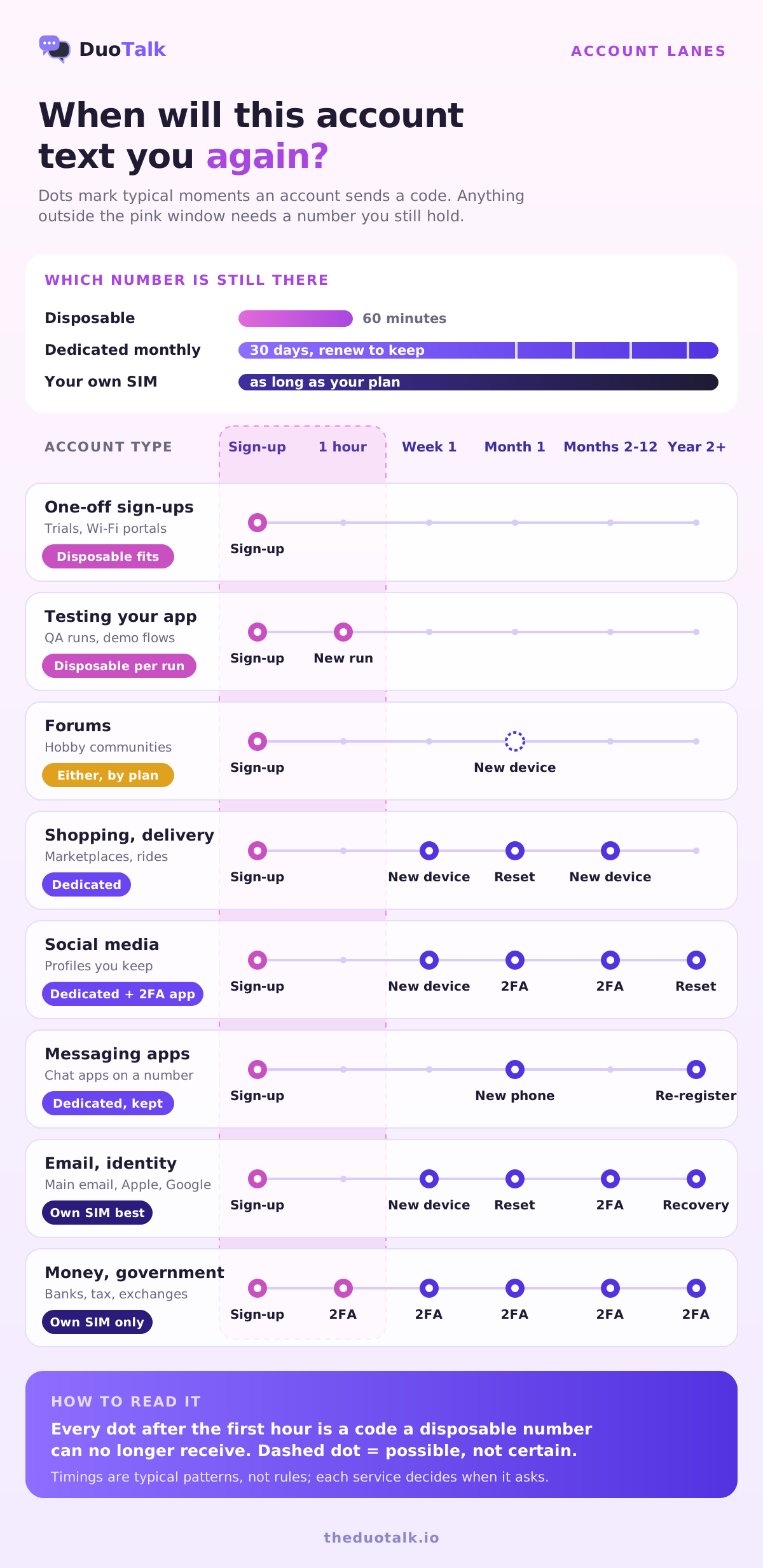
As a rule, the longer and more valuable an account's life, the more it needs a dedicated number. One-off and low-value accounts are fine on a disposable number; identity, money and communication accounts are not. The table maps common account types.
| Account type | Examples | Disposable number | Dedicated monthly number | Your own SIM |
|---|---|---|---|---|
| One-off sign-ups | Free trials, giveaways, Wi-Fi portals, one download | Good fit | More than you need | Exposes your number |
| Forums and communities | Hobby forums, comment accounts | Fine if you never need recovery | Better if you will stay | Optional |
| Testing your own product | QA accounts, sign-up flow tests | Good fit | Good for long-running test accounts | Not needed |
| Shopping and delivery | Marketplaces, food delivery, ride apps | Risky: re-logins are common | Good fit | Good fit |
| Social media | Profiles you post on for months | Risky | Good fit, with a backup 2FA method | Good fit |
| Messaging apps | Chat apps tied to your number | Poor fit: re-registration needs the number | Good fit while you renew | Best fit |
| Email and identity | Your main email, Apple or Google account | Avoid | Workable with backup codes | Best fit |
| Work tools | Team chat, cloud accounts | Avoid | Good fit for a separate work identity | Good fit |
| Banking, tax, government, crypto exchanges | Anything with identity checks or money | Avoid | Follow the service's rules; keep it long term | Best fit |
Real account examples
These five examples show the decision in practice. Numbers in them are fictional.
1. A one-week design tool trial. You want to try a tool before your company buys it. You will not keep the account. A disposable number receives the sign-up code, the trial ends, nothing is lost. Right choice: disposable.
2. A secondhand marketplace account. You plan to sell a few items over the next months. Buyers message you inside the app, and the app asks for a code whenever you sign in on a new phone. A disposable number would work on day one and fail at the first new-device login. Right choice: dedicated monthly number, renewed while you sell, or your own SIM.
3. A second messaging app identity for freelance work. You want clients to reach you without seeing your personal number. Messaging apps tie the account to the number and send a new code when you reinstall or move phones. Right choice: dedicated, kept for as long as the identity is in use. Our guide to a private SMS verification number covers privacy settings for this case.
4. A QA engineer testing a sign-up flow. Each test run needs a fresh code, and the accounts are deleted afterwards. Right choice: disposable numbers, one per run. For long-lived staging accounts that testers sign in to every week, add one dedicated number.
5. A new email account that will receive your bills. This account becomes the recovery address for other accounts. If you lose it, you can lose them too. Right choice: your own SIM, or a dedicated number plus backup codes and an authenticator app, never a disposable number.
Virtual number vs real phone number: where a SIM still wins
A virtual number is a number you use through an app or website with no SIM card, while a real phone number in everyday speech is a mobile number on a SIM or eSIM from a carrier. Both can be dedicated. A virtual number wins on privacy and speed; a SIM wins on ownership and acceptance.
| Virtual number (disposable or dedicated) | Real SIM or eSIM number | |
|---|---|---|
| Needs a SIM or phone plan | No | Yes |
| Read codes in a browser | Yes | No, on the phone |
| Linked to your identity | Not by the number itself | Often, through carrier registration |
| Can be ported to another carrier | No | Yes, in most countries |
| Accepted by strict services | Varies; some refuse VoIP or virtual ranges | Almost always |
| Lasts for years | Only while you renew, if offered | Yes, while the plan is active |
Why strict services prefer a real SIM
Banks, tax portals, government services and crypto exchanges often check the line type, and many require a number that can be tied to a verified person. Following their rules is part of using them. For these accounts, use your own number in your own name and protect it with a carrier port-out PIN. The FCC explains SIM swapping and port-out fraud in its cell phone fraud guide, and most carriers let you lock your number against unauthorised transfers.
Why SMS should not be your only lock
Whatever number you choose, SMS codes are a weaker second factor than an authenticator app or a passkey. NIST's digital identity guidelines treat authentication through the phone network as "restricted" and expect services to offer alternatives (NIST SP 800-63B-4). CISA goes further and urges phishing-resistant methods such as passkeys and security keys, describing SMS and voice codes as a last resort (CISA fact sheet).
So the practical rule is: a dedicated number for the account's phone field, plus an authenticator app or passkey for the actual protection, plus saved backup codes. That way a lost or recycled number is an inconvenience, not a lockout.
How to use each type safely
Use a disposable number for one code inside its window, and treat a dedicated number like a key you are responsible for: renew it, back it up, and move accounts off it before you let it go. The steps below cover both, plus the switch from one to the other.
Using a disposable number, step by step
- Confirm the account is truly one-off. Run the quick test above. If you hesitate, choose dedicated.
- Choose the right service and country. A one-time verification number is usually tied to the one service you pick, so choose the exact app you are signing up for.
- Enter the number in international format. Use the country code and drop any leading trunk zero, for example +44 7700 900123 rather than 07700 900123.
- Request the code once and wait. Give it a full two minutes before tapping resend. Repeated requests can trigger rate limits.
- Copy the code straight away. Most codes expire in 5 to 15 minutes on the service side, whatever your number window is.
- Add another sign-in method if the service offers one. An email address or authenticator app keeps the account reachable after the number closes.
- Remove the number from the account if you plan to keep it after all. Replace it with a dedicated number before the window ends.
If no code comes, do not keep buying new numbers in a rush. Check the number format and the country picker first. Our temporary phone number for verification guide has a full troubleshooting order.
Using a dedicated number, step by step
- Pick a country the service accepts and that fits where you use the account.
- Put the number, service and end date in your password manager. One line per account linked to it.
- Set a reminder a week before the end date. On DuoTalk nothing renews automatically, so the reminder is your safety net.
- Add a second factor that is not SMS. Authenticator app or passkey, plus backup codes stored offline.
- Renew before the end, not after. An expired number cannot be brought back.
- When you stop, move first, then let go. Change the phone number on every linked account, confirm with a test login, and only then let the number lapse.
The number lifecycle page shows what happens at each stage of a number's life, and the help article on extending and renewing numbers shows exactly where the renew button is.
Switching from a disposable to a dedicated number
If you signed up with a disposable number and now want to keep the account, fix it while you can still log in:
- Get the dedicated number first and keep it open in another tab.
- Open the account's security settings. On a Google Account, the phone is under Security, then the recovery phone setting; on an Apple Account, it is under Sign-In & Security as a trusted phone number (menu names change over time). See Google's recovery options help and Apple's trusted phone number help.
- Add the new number and confirm the code it receives.
- Remove the old disposable number so a future holder cannot receive your codes.
- Add an authenticator app or passkey and save backup codes.
- Sign out and back in on a second device to test that everything works.
If the account will not let you change the number without a code sent to the old one, and the disposable number has closed, your only routes are backup codes, a recovery email or the service's support team. That is exactly the situation a dedicated number prevents.
When something goes wrong
| What you see | Likely cause | What to do |
|---|---|---|
| No code on a disposable number | Wrong country selected, format error, or a slow route | Check the format, wait two minutes, then extend or report (see below) |
| "Number already registered" or "already in use" (wording varies) | A recycled number still linked to an older account | Use a different number; do not try to take over the existing account |
| Code arrived but sign-up still fails | The service rejected the number type or range after sending the code | Try a different number type or country the service accepts |
| Login code goes to a number you no longer have | Account left on a disposable or expired number | Use backup codes, recovery email or the service's support |
| Monthly number never received anything | The service is not sending to that number | Request a refund within the window and pick another number |
Disposable and dedicated numbers on DuoTalk
DuoTalk (theduotalk.io) is a web app for getting virtual phone numbers to receive SMS online in a private inbox. It offers both types discussed in this guide: short-term numbers for one code and monthly numbers for accounts you keep. Both receive SMS only; they cannot send messages or take calls.
| Short-term (disposable) | Monthly (dedicated) | |
|---|---|---|
| How long | 60 minutes from purchase; stays open 7 more minutes after the first code | 30 days |
| Receives SMS from | Only the one service you chose at purchase | Any service |
| No code arrives | Extend once for free (another hour, same number); if it still fails, report it and the money returns to your DuoTalk balance | Refund on request within 48 hours if the number never receives an SMS |
| Renewal | Paid renewal for another hour while the number is still available; never after its end date | Renew from your numbers list before the 30 days end; nothing renews automatically |
| Countries | Many, depending on live stock | Some countries only |
How to get either type:
- Top up your balance. Top-ups are in crypto: USDT (TRC20 or BEP20), TRX, LTC, BTC or ETH. The balance is added once the network confirms, and no fees or tax are added at checkout.
- Open the Numbers page and choose the service and country. See live numbers and prices for what is in stock right now.
- Pick short-term or monthly using the quick test in this guide.
- Paste the number into the sign-up form and read the code in your DuoTalk inbox, usually within seconds on tested routes.
- For monthly numbers, note the end date and renew from your numbers list before it passes.
A code arriving does not guarantee that the service will accept the number, because each service sets its own rules and changes them. If you want the wider picture of every way to receive SMS online, from public inboxes to eSIMs, start with our guide on how to receive SMS online privately. For more on the renting side of monthly numbers, see how to rent a phone number.
Questions people also ask
What is a disposable phone number?
A disposable phone number is a temporary number used for a short time or a single purpose, usually to receive one verification code, and then dropped. It may be a private one-time number from an SMS verification service, a burner app line or a public inbox number. The private kind shows the code only to you; the public kind shows it to anyone. Either way, it will not receive later login or recovery codes.
Are disposable phone numbers safe?
Private disposable numbers are safe for one-off sign-ups; public ones are not. On a free public inbox, anyone can read your code and use it before you do. Even a private disposable number becomes a risk if you leave a valuable account linked to it, because the number returns to a pool and may later reach a stranger. Use disposable numbers only for accounts you will not need to recover.
Can I use a disposable number for two-factor authentication?
No, not in any useful way. Two-factor authentication sends a code every time you sign in on a protected device, and a disposable number closes within about an hour. If SMS 2FA is tied to it, you will be locked out at your next login. Use a dedicated number you renew, and add an authenticator app or passkey as well, since NIST and CISA both rate SMS codes as a weaker method.
What is the difference between a dedicated number and a virtual number?
They describe different things. "Virtual" means the number works without a SIM, through an app or website. "Dedicated" means it is reserved for one person for an ongoing period. A number can be both: a monthly virtual number is virtual and dedicated. A disposable verification number is virtual but not dedicated, and a carrier SIM number is dedicated but not virtual.
What happens to my account when a disposable number expires?
The account stays, but it now points at a number you can no longer read. Anything that needs a new SMS code, such as a new-device login, password reset or 2FA prompt, will fail unless you have another method like a recovery email or backup codes. Later, the number may be given to someone else, who could receive codes meant for your account.
Can a disposable phone number be traced back to you?
Not through the number alone in most cases, but it is not anonymous. A verification provider knows which customer bought the number and when, and the service you signed up for still sees your IP address, device and payment details. Disposable numbers protect your real number from being shared or leaked; they do not hide who you are from law enforcement or from the platform itself.
Should I get a dedicated number for WhatsApp or Telegram?
Yes, if you plan to keep the account. Messaging apps tie the account to the number and ask for a new SMS code when you reinstall, change phones or re-register. A disposable number works only for the first code. With a dedicated number you can receive those later codes while you renew it, and you should also set the app's own PIN or password for extra protection.
Sources
- NIST SP 800-63B-4: Digital Identity Guidelines, Authentication and Authenticator Management
- CISA: Implementing Phishing-Resistant MFA (fact sheet)
- 47 CFR 52.15: aging of disconnected numbers, eCFR
- FCC: Reassigned Numbers Database
- FCC Consumer Guide: Cell Phone Fraud
- Lee and Narayanan, Princeton University: Security and Privacy Risks of Number Recycling at Mobile Carriers in the United States
- WhatsApp Help Center: About seeing your phone number already in WhatsApp
- Google Account Help: Set up recovery options
- Apple Support: Trusted phone numbers and trusted devices
Last reviewed: November 2026