Best Virtual Phone Number for SMS Verification: What to Look For
The best virtual phone number for SMS verification depends on the job. A 6-point rubric, picks for WhatsApp, long-term accounts and travel, and red flags.
By the DuoTalk team · Published 2026-11-11 · Updated 2026-11-11
The best virtual phone number for SMS verification is not one product or one provider. It is the number that fits the job: a private, mobile-type number in the country the service expects, held for as long as you need that account. A number that is perfect for a one-off trial can be the worst possible choice for WhatsApp, and the right pick for a developer running sign-up tests is wrong for a traveller. This guide gives you a scoring rubric you can apply to any option, the best number type for each common job, and the red flags that should make you walk away.
The short answer: The best virtual number for SMS verification is private (only you can read the inbox), mobile-type rather than VoIP, from the country the service expects, and kept for as long as you will need codes for that account. Use a short-term number for one-off sign-ups, a monthly number for accounts you keep, and your own SIM for banking and government services.
If you want the full step-by-step buying checklist rather than job-by-job picks, read our guide to choosing a virtual phone number for SMS. This post assumes you know what a virtual number is and want to know which one wins for your situation.
What makes a virtual phone number the best for SMS verification?
A virtual number is the best for SMS verification when it receives the code, the service accepts it, nobody else can read it, and it is still yours on the day the service asks for a code again. Those four outcomes depend on six things you can check before paying: inbox privacy, line type, country, how long you can keep it, what happens if no code arrives, and how quickly codes land.
Most "best virtual number" lists rank brands. That is the wrong unit. Two numbers from the same seller can behave very differently: a 60-minute number and a 30-day number are different tools, and a US number and a UK number pass different country checks. Rank the number type for the job instead, and the choice gets simple.
Virtual number vs real phone number: what changes for verification
A virtual number is a real, dialable number with no SIM card in your hand; texts sent to it arrive in an online inbox. A real phone number on your own SIM or eSIM is tied to you by your carrier, rings your handset and stays yours while you pay your plan. For verification, the differences that matter are acceptance, recovery and privacy.
| Attribute | Private virtual number | Your own SIM or eSIM number |
|---|---|---|
| Where codes arrive | Online inbox (web or app) | Your phone's messages app |
| Who can read codes | Only you, if the inbox is private | Only you (and anyone holding your phone) |
| Exposes your personal number | No | Yes |
| Acceptance by strict services | Varies by service and line type | Highest |
| Recovery months later | Only while you still hold the number | Yes, while your plan is active |
| SIM swap risk to your main identity | Separated from your main line | Your main line is the target |
| Typical use | Sign-ups, second identities, testing, travel | Banking, government, primary email |
Neither column wins everywhere. Your own number has the best acceptance and recovery; a private virtual number has the best privacy and keeps your real number out of sign-up databases, marketing lists and data leaks. The rest of this guide is about picking the right virtual number when a virtual number is the right tool.
The 6-point rubric for scoring any virtual number
Score each option from 0 to 3 on six criteria, for a maximum of 18. A score is only useful against the job, so after scoring, check the two or three criteria your use case weights most (the next section lists them). An option scoring 15 with a 0 on the criterion your job depends on is still the wrong pick.
| Criterion | 0 points | 1 point | 2 points | 3 points |
|---|---|---|---|---|
| 1. Inbox privacy | Public web page anyone can read | Shared app inbox or unclear | Private, but tied to an account you cannot secure | Private inbox behind your own login |
| 2. Line acceptance | Known VoIP range often refused | VoIP, accepted by some services | Mobile-type, mixed results | Mobile-type (non-VoIP), widely accepted |
| 3. Country match | Wrong country for the service | Neighbouring country | Right country, limited stock | Right country, in stock now |
| 4. Keepability | Gone in minutes, no way back | Single session (about an hour) | Weeks, renewal unclear | 30 days or more with clear renewal |
| 5. No-code protection | No help if nothing arrives | Support ticket only | Refund or swap after a delay | Free retry, then refund to balance |
| 6. Speed and window | Codes often late or missing | Minutes, short window | Seconds, short window | Seconds, window long enough for a second code |
A few notes on scoring honestly:
- Inbox privacy is pass or fail for anything you keep. A public inbox shows your code to every visitor, and a code is all someone needs to take over a fresh account. Our guide to choosing a private SMS verification number covers this criterion in depth.
- Line acceptance depends on a lookup the service runs on your number. Mobile ranges pass more often than VoIP ranges; the background is in our explainer on what a non-VoIP number is.
- Keepability is the criterion people skip and regret. Google's own help page for recovery options says not to use a Google Voice number as a recovery phone, because you may not be able to get the code when you are locked out, and recommends a phone that receives texts and belongs only to you (Google Account Help). The same logic applies to any number you may lose.
- Cost is a tiebreaker, not a criterion. A cheaper number that loses you the account costs more than the price difference.
Best virtual number for each job
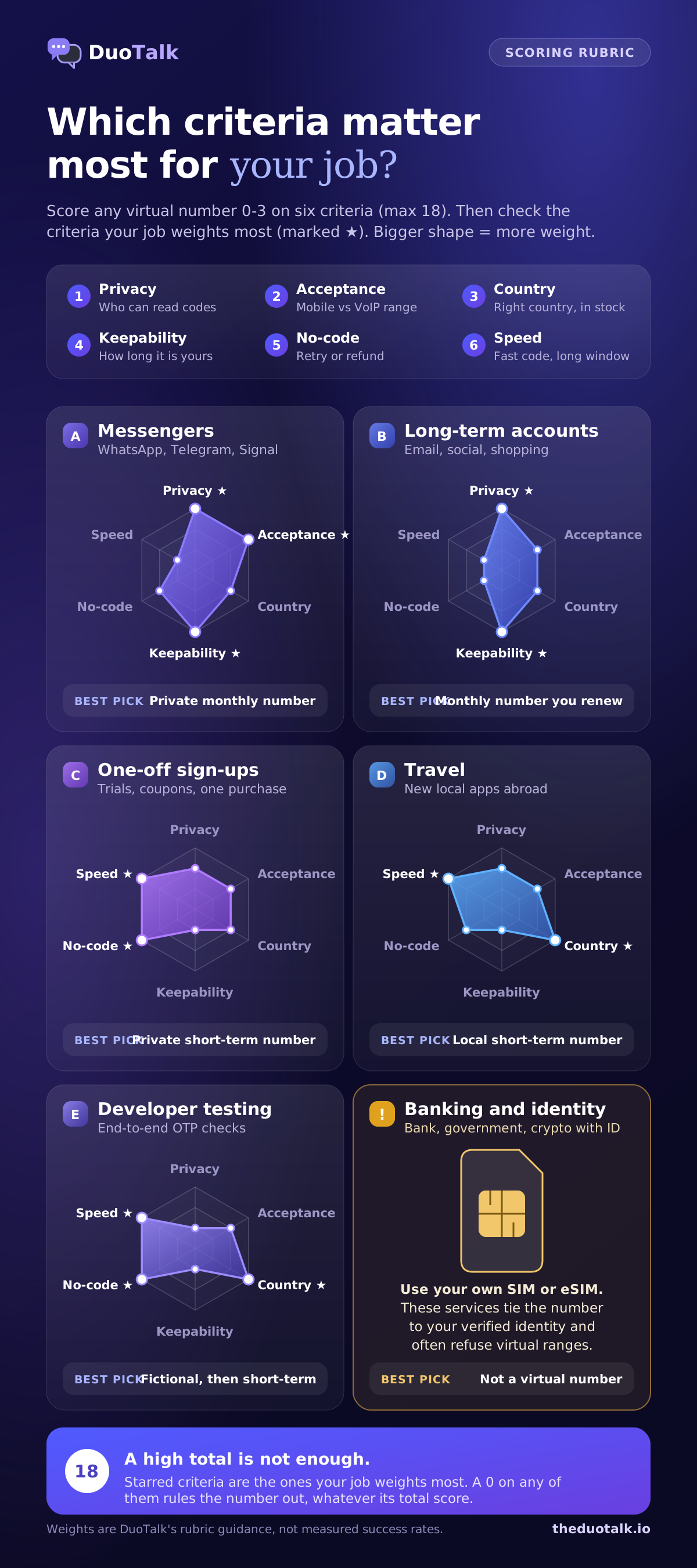
The best number type changes with the job. Here are the picks for the six situations people ask about most, with the rubric criteria that carry the most weight for each. "Weight" means how much a low score on that criterion will hurt you, not a measured success rate.
| Job | Best number type | Criteria that matter most | Main watch-out |
|---|---|---|---|
| WhatsApp, Telegram, Signal | Private monthly number, or your own second SIM | Privacy, acceptance, keepability | Re-verification on a new device |
| Long-term accounts (email, social, shopping) | Private monthly number you renew | Privacy, keepability | Letting the number lapse |
| One-off sign-ups and trials | Private short-term number | No-code protection, speed | Using it for an account you later want back |
| Travel | Home SIM or eSIM for home accounts; local short-term number for new local apps | Country match, speed | Losing access to home accounts abroad |
| Developer testing | Fictional test numbers first, then short-term real numbers | Country match, speed, no-code protection | Hardcoding test numbers in production |
| Banking, government, crypto with identity checks | Your own SIM or eSIM | Acceptance, keepability | Using any number you cannot keep |
Best virtual number for WhatsApp and other messengers
For WhatsApp, the best virtual number is a private number you can keep, because WhatsApp asks for a fresh code whenever you register the account on a new phone. WhatsApp's help centre describes registration as confirming your number with a 6-digit code sent by SMS or call (WhatsApp Help Center). If the number is gone when you switch phones, the account may be gone with it.
What to look for:
- A monthly (30-day) number with clear renewal, scored 3 on keepability. Renew before the term ends, every time.
- A mobile-type number in the country you want to appear from. Messengers check line type, and some ranges are refused outright.
- A private inbox. A messenger account is your identity to everyone who talks to you.
- Two-step verification turned on inside the app once you are in, so a stolen code alone cannot move the account.
A one-time virtual number for WhatsApp works for registration, but it scores 1 on keepability and should be used only for an account you are happy to lose. Telegram and Signal follow similar logic: Telegram often sends later login codes to your existing sessions, which softens the risk, but a new device with no active session still needs the number. Our step-by-step guide to a virtual number for WhatsApp covers the registration screens and common errors.
Best virtual number for long-term accounts
For accounts you plan to keep (a secondary email, a social profile, a marketplace seller account, a shopping account with saved cards), the best virtual number is a private monthly number that you renew without gaps. Keepability outweighs everything else here, because services ask for codes again at new-device logins, password resets and security reviews, sometimes months after sign-up.
The risk of a lapsed number is not just losing access. Numbers are recycled. In the US, carriers may reassign a disconnected number after an aging period, which federal rules set at 45 to 90 days for residential numbers (47 CFR 52.15), and virtual number pools are reused too. A future holder of your old number could receive a code meant for you. That is why a dedicated number beats a disposable one for anything you keep; our comparison of disposable vs dedicated phone numbers walks through real account examples.
Practical rules for long-term accounts:
- Put the renewal date in your calendar the day you buy the number.
- Add a second recovery method in every account (an email you control, an authenticator app, backup codes).
- If the account matters more than the privacy benefit, use your own number instead. Primary email and anything holding money fall into that group.
Best virtual number for one-off sign-ups and trials
For a one-off sign-up, the best virtual number is a private short-term number with a free retry and a refund if no code arrives. You need one code, quickly, and you do not plan to log in again from a new device. Keepability barely matters; no-code protection and speed matter a lot.
Good fits: a free trial you want to test without marketing texts, a coupon or loyalty sign-up, a one-time purchase, a forum you will read for a week. Poor fits: anything you might want back after the number expires, even "just in case". If there is any chance you will keep the account, pay for the monthly option now; it is cheaper than losing the account later.
A private short-term number also beats a free public inbox on privacy (3 against 0) and usually on acceptance, because public numbers are reused by thousands of visitors and many services already refuse them. When you are ready, you can see live short-term numbers by service and country and pick one that matches the app you are trying.
Best virtual number for travel
For travel, the best answer depends on which accounts need codes. For your existing home accounts (bank, email, airline apps), keep your home number reachable: leave your home SIM active with SMS roaming, or move it to an eSIM, so codes still arrive abroad. For new local services you only need during the trip (a ride app, a local delivery app, a venue's Wi-Fi sign-up), a short-term number in the local country is often the best fit.
What matters most for travellers:
- Country match. Local apps may only accept local numbers, and some send codes only to their own country's ranges.
- Access over Wi-Fi. A virtual number's inbox opens in a browser, so you can read codes on hotel Wi-Fi without roaming charges.
- A plan for coming home. If a local account will matter after the trip (a rental platform you will use again, say), give it a monthly number or your own number, not a 60-minute one.
Never move your bank or primary email to a temporary number before a trip. Losing your phone abroad is stressful enough without losing the number those accounts trust.
Best virtual number for developers testing SMS sign-up
For developers, the best "number" for most tests is a fictional one that never sends an SMS. Firebase Authentication, for example, lets you register up to 10 fictional phone numbers with fixed codes for development; they do not use your SMS quota, do not send real messages and are not throttled (Firebase documentation). In North America, the block 555-0100 through 555-0199 is reserved for fictitious use, so it is a safe placeholder in screenshots and demos (NANPA).
Fictional numbers prove your code calls the API correctly. They do not prove a real text reaches a real handset. For that, run end-to-end tests with real numbers:
- Short-term numbers in each country you support, so you can see real delivery times and sender IDs from your SMS provider.
- Several carriers or ranges, because delivery can differ by route.
- A no-code policy you can rely on, since failed tests are part of testing and you should not pay twice for a number that received nothing.
- API access if you run tests often; DuoTalk offers developer API access for this kind of automated flow.
Keep test numbers and their codes out of production builds. Firebase's own documentation warns against hardcoding fictional numbers in production apps.
When a virtual number is not the best choice
For online banking, government portals, tax services, payment apps and crypto exchanges with identity checks, the best number is your own SIM or eSIM. These services tie your number to your verified identity, use it for fraud alerts and recovery, and often refuse virtual ranges. Follow each service's identity rules and use a number you will keep for years.
This is also where security advice points. The US Federal Trade Commission notes that texted codes can be intercepted through a SIM swap, that authenticator apps are safer and that security keys are the strongest option (FTC Consumer Advice). NIST's digital identity guidelines class SMS and voice codes as a "restricted" authenticator for the same reason (NIST SP 800-63B). Use the phone number to get in, then switch the account's second factor to an authenticator app or passkey where the service allows it. The FCC's guide to cell phone fraud explains how SIM swapping and port-out scams work, and why the number your bank trusts should be one you control directly.
Red flags: signs a virtual number is the wrong pick
A virtual number service is the wrong pick when it hides who can read your codes, cannot tell you how long the number is yours, or keeps your money when nothing arrives. Most bad experiences with virtual numbers trace back to one of the warning signs below, and every one of them is visible before you pay.
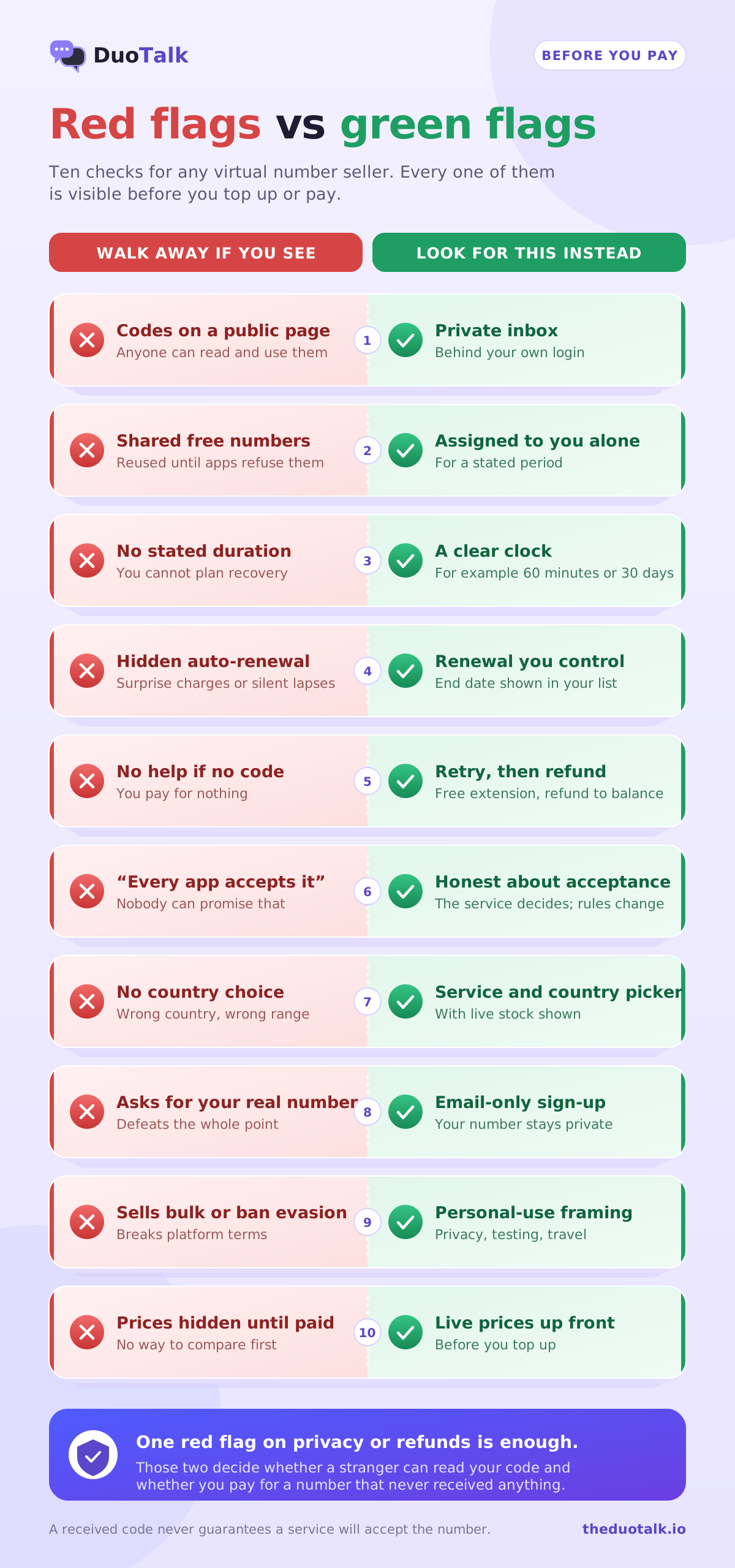
| Red flag | Why it hurts | Green flag to look for instead |
|---|---|---|
| Codes shown on a public web page | Anyone can read and use your code | Private inbox behind your own login |
| "Unlimited free numbers" with no account | The same numbers are reused by everyone, so services refuse them | A number assigned to you alone for a stated period |
| No stated duration | You cannot plan recovery | A clear clock (for example 60 minutes or 30 days) |
| Auto-renewal you cannot see or stop | Surprise charges, or a silent lapse when a card fails | Renewal you trigger yourself, with the end date shown |
| No policy for "no code arrived" | You pay for nothing | Free retry, then a refund to your balance |
| Promises that every service will accept the number | No seller can promise that; services change rules | Honest note that acceptance is up to the service |
| No country or service selection | Wrong country, wrong range | Pick by service and country, with live stock shown |
| Asks for your personal number to "verify" you | Defeats the purpose | Sign-up with email only |
| Encourages bulk accounts or ban evasion | Breaks platform terms and puts your account at risk | Privacy and personal-use framing |
| Stock and prices you cannot see before paying | Hidden mismatch | Live prices and stock visible before checkout |
One more check: how the service answers when you ask what happens after expiry. Our number lifecycle page is an example of the kind of plain answer to look for: when a number stops receiving, what stays in your history and when it may be reassigned.
Worked examples: scoring options with the rubric
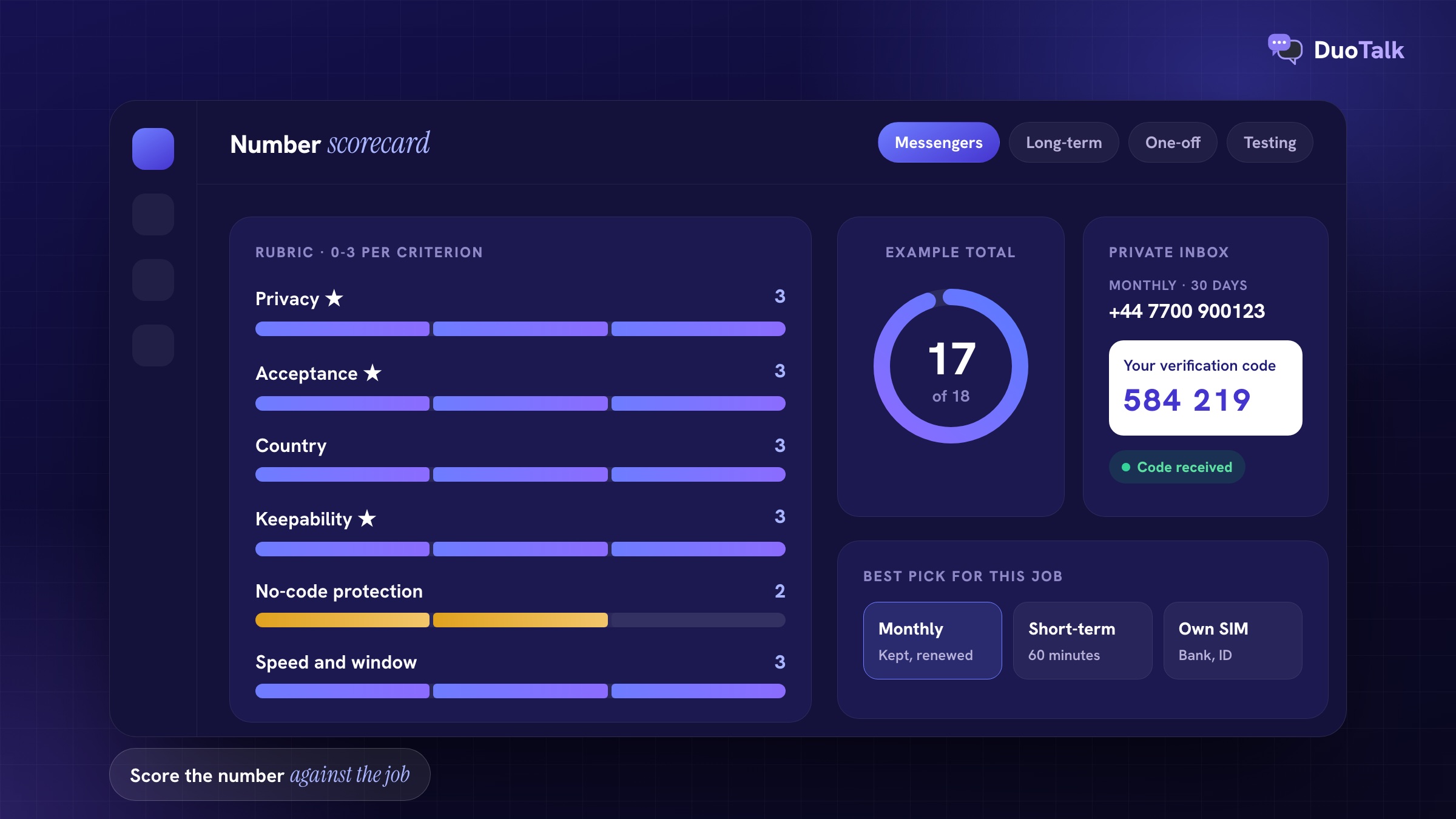
Scoring takes about two minutes per option once you know the rubric. The three examples below show how the same options come out differently depending on the job. Scores are our illustrative judgements using the rubric above, not measured success rates.
Example 1: a second WhatsApp account for a side business
Maya wants a separate WhatsApp for her weekend cake orders, so customers never get her personal number. She will use it for at least a year and may change phones.
| Option | Privacy | Acceptance | Country | Keep | No-code | Speed | Total |
|---|---|---|---|---|---|---|---|
| Free public inbox number | 0 | 0 | 1 | 0 | 0 | 1 | 2 |
| Free calling-app number | 2 | 1 | 3 | 2 | 0 | 2 | 10 |
| Private short-term number | 3 | 2 | 3 | 1 | 3 | 3 | 15 |
| Private monthly number | 3 | 2 | 3 | 3 | 3 | 3 | 17 |
| Second physical SIM | 3 | 3 | 3 | 3 | 1 | 3 | 16 |
We give both private numbers a 2 on acceptance, not 3, because whether a messenger accepts a virtual number varies by range and country. The short-term number scores well overall but fails the criterion her job depends on: keepability. The monthly number she renews comes out just ahead, and a second SIM is the better pick if she also wants to make calls or wants the highest acceptance. A virtual number that receives SMS only cannot place calls, so customers who phone her would need another route.
Example 2: a 7-day trial of a design tool
Sam wants to test a design app for a week, then probably cancel. He wants no marketing texts afterwards.
Here the private short-term number wins. Keepability scores 1, but Sam's job gives it almost no weight; no-code protection and speed carry the job. A monthly number would work too, but he would pay for 29 days he does not need. The free public inbox is still out: it scores 0 on privacy, and many tools reject those numbers anyway.
Example 3: a developer checking OTP delivery to the UK
Nadia's team launches in the UK next month. Unit tests use Firebase fictional numbers. For the release check, she needs to see a real code arrive on a real +44 mobile range.
She buys short-term UK numbers (for example a 07700 900xxx-style mobile, though real numbers come from live stock), runs the sign-up flow, records how long each code took and what sender ID appeared, and reports any number that still received nothing after its free extension, so the money goes back to the team's balance. Country match and speed carry this job; keepability does not matter.
How to test a virtual number before you trust it with an account
You can confirm a virtual number is right for your account in five steps, before anything important depends on it. The goal is to find out early whether the number receives codes from your exact service, and whether you can keep it.
- Check the service and country match. Choose the number for the exact service (WhatsApp, Google, Telegram) and the country the service expects. On DuoTalk, short-term numbers receive SMS only from the one service chosen at purchase, while monthly numbers receive SMS from any service.
- Request the code once, then wait. Codes usually arrive within seconds on tested routes. Requesting again and again can trigger a service's rate limit (the wording varies, often "Too many attempts, try again later").
- Read the error, not just the silence. "This number cannot be used for verification" or "number not supported" (wording varies) means the service refused the number, not that delivery failed. Our guide to why a virtual number is not accepted maps each error to a fix.
- Log out and back in once on a second browser or device, if the account will be kept. If the service asks for a code again, you know it re-verifies, and keepability matters.
- Set up a second recovery method straight away: an email you control, an authenticator app, or backup codes.
If you want the wider picture first, our complete guide on how to receive SMS online compares every route (public inboxes, apps, private numbers, eSIM) side by side.
Troubleshooting: when the best number still fails
Even a well-chosen number can fail, and the cause is usually one of four things: delivery, the service's own checks, timing or the wrong number type for the job. Work through them in order.
| Symptom | Likely cause | What to do |
|---|---|---|
| No code after several minutes | Delivery route, or the service did not send | Wait the full window, request once more, then switch number or extend |
| "Number not supported" or similar (wording varies) | Line type, number reputation or country check | Try a different country or range; see the error map in our rejection guide |
| "Too many attempts" | Rate limit on the service side | Wait (often an hour or more), do not keep retrying |
| Code arrives but sign-up still fails | Service flagged the session (IP, device, behaviour) | Use your normal browser and connection, complete the profile, try later, or contact the service's support |
| Account asks for a code weeks later and the number is gone | Short-term number used for a long-term account | Use recovery email or backup codes; next time use a monthly number |
A code arriving never guarantees the service will accept the number. Services change their rules without notice, and the number can be refused even after the code is sent. Any seller that tells you otherwise has earned a red flag.
How to get a verification number on DuoTalk
DuoTalk (theduotalk.io) is a web app for getting a private virtual phone number to receive SMS online for verification codes, so you do not hand out your personal number. It offers the two number types this guide recommends for most jobs, and both inboxes are private to your account.
| Short-term number | Monthly number | |
|---|---|---|
| How long it works | 60 minutes after purchase | 30 days |
| After the first code | Stays open 7 more minutes for a second code | Keeps receiving until the term ends |
| Which services it receives from | Only the service chosen at purchase | Any service |
| If no code arrives | Extend once for free (another hour), then report for a refund to balance | Refund on request within 48 hours if it never receives an SMS |
| Renewal | Not renewable | Nothing renews automatically; renew from your numbers list before the 30 days end |
| Best for | One-off sign-ups, trials, testing | Messengers, long-term accounts |
| Availability | Many countries, changing with stock | Some countries only |
Steps:
- Top up your balance. Top-ups are crypto only (USDT on TRC20 or BEP20, TRX, LTC, BTC or ETH). The balance is added automatically once the network confirms. There are no fees or tax added at checkout.
- Open the Numbers page and choose your service and country. Live stock and live prices are shown there; check live prices on the Numbers page before you decide.
- Pick short-term or monthly using the job table above.
- Request the code in the app or site you are signing up for and watch your DuoTalk inbox. Codes usually arrive within seconds on tested routes.
- If nothing arrives, use the free extension on a short-term number, then report it if it still fails. Here is how reporting and refunds to your balance work.
DuoTalk numbers receive SMS only: they cannot send messages or take calls. And as with any provider, a received code does not guarantee the service will accept the number.
Questions people also ask
What is the best virtual number for verification?
The best virtual number for SMS verification is a private, mobile-type number in the country the service expects, held for as long as you need the account. For one-off sign-ups that means a short-term private number; for WhatsApp or any account you keep, a monthly number you renew. No single provider or number works for every service, because each service runs its own checks on line type, country and reputation, and those rules change.
Is it safe to use a virtual number for verification?
It is safe when the inbox is private and you can keep the number for as long as the account needs it. The risks come from public inboxes, where anyone can read your code, and from numbers that expire and get reassigned while your account still trusts them. For banking, government and payment services, use your own SIM, and add an authenticator app or passkey wherever a service offers one.
Can I use a virtual number for WhatsApp verification?
Yes, WhatsApp can be registered with a virtual number that receives SMS, but acceptance depends on the number's range and country. Choose a number you can keep, ideally a monthly one, because WhatsApp sends a new 6-digit code when you register on a new phone. Turn on two-step verification in WhatsApp's settings right after you register, so a code alone is not enough to move your account.
What is the difference between a virtual number and a real phone number?
A virtual number has no SIM in your phone: texts arrive in an online inbox you open in a browser or app. A real phone number sits on your SIM or eSIM and is tied to you by your carrier. For verification, real numbers are accepted by more services and are easier to recover, while private virtual numbers keep your personal number out of sign-up forms, marketing lists and data breaches.
Why do some apps not accept virtual numbers?
Apps refuse virtual numbers mainly because of a line-type lookup that flags VoIP ranges, a poor reputation for numbers reused by many people, or a country mismatch with your account or IP address. Rate limits after repeated requests can look like a refusal too. Mobile-type numbers in the right country pass more often, but no number type passes every service, and rules change without notice.
Can I keep a virtual phone number permanently?
Not permanently in one purchase, but you can keep a monthly virtual number for as long as you renew it before each term ends. On DuoTalk, nothing renews automatically, so set a reminder and renew from your numbers list before the 30 days are up. If a number lapses, it stops receiving texts and may later be reassigned, which is why accounts you care about need a number you actively renew.
Are free virtual numbers good for verification?
Free numbers are fine for throwaway sign-ups where losing the account costs you nothing, but they are poor for anything you keep. Most free numbers are public, so other visitors can read your code, and they are reused so heavily that many services refuse them. A private paid number scores higher on privacy, acceptance and no-code protection, which is why it usually wins on our rubric.
Sources
- Google Account Help: Set up recovery options
- WhatsApp Help Center: How to register your phone number
- FTC Consumer Advice: Use two-factor authentication to protect your accounts
- NIST SP 800-63B: Digital Identity Guidelines, Authentication
- 47 CFR 52.15: number aging rules (Cornell LII)
- Firebase Authentication: phone sign-in and fictional test numbers
- NANPA: 555 line numbers
- FCC consumer guide: Cell phone fraud
Last reviewed: November 2026