10 Best Temporary Phone Number Services for SMS Verification
The best temporary phone number services for SMS codes: ten real options, from private numbers to prepaid SIMs and free inboxes, rated on five criteria.
By the DuoTalk team · Published 2026-11-04 · Updated 2026-11-11
The best temporary phone number services for SMS verification are the ones that get your code accepted without exposing your real number or locking you out later. In 2026 there are ten realistic ways to do that, from a private paid number that lasts an hour to a full carrier line, plus free options that range from usable to risky. We rated all ten on five criteria, ranked them for a typical private sign-up, and paired each with the job it does best.
The short answer: For a one-off sign-up, the best temporary phone number is a private paid short-term number: only you can read the inbox, the line is usually mobile-type, and it costs little. For an account you will log in to again, use a private monthly number or a real carrier line. Avoid free public inbox sites for anything you want to keep.
What counts as a temporary phone number service?
A temporary phone number service is any way to get a working phone number that you use for a limited purpose, usually to receive a verification code, without giving out your main number. That covers far more than "temp number" websites. A cheap prepaid SIM, a travel eSIM, a free calling app and a private number you rent for 60 minutes all do the same basic job: receive a text that proves you control a number.
They differ in three ways that matter for verification:
- Who can read the messages. A private number shows codes only to you. A public inbox shows them to anyone on the internet.
- What the number looks like to the sender. Services run a line-type lookup that labels a number as mobile, landline, fixed VoIP or non-fixed VoIP. Many refuse VoIP. Our guide to non-VoIP numbers explains how that check works.
- How long you keep it. An hour, a month, or as long as you pay a carrier. This decides whether you can log back in or recover the account later.
If you want the full map of methods before you choose a provider, start with our guide on how to receive SMS online privately. This page is the ranked shortlist.
Temporary number for online registration vs a number you keep
A temporary number for online registration is meant to receive one or two codes and then go. That suits a trial, a download or a one-time purchase. It is the wrong tool for anything tied to money, identity or long-term recovery, because the service may text that number again in six months and it will not be yours. The difference is covered in depth in disposable vs dedicated phone numbers.
How we rated and ranked the 10 options
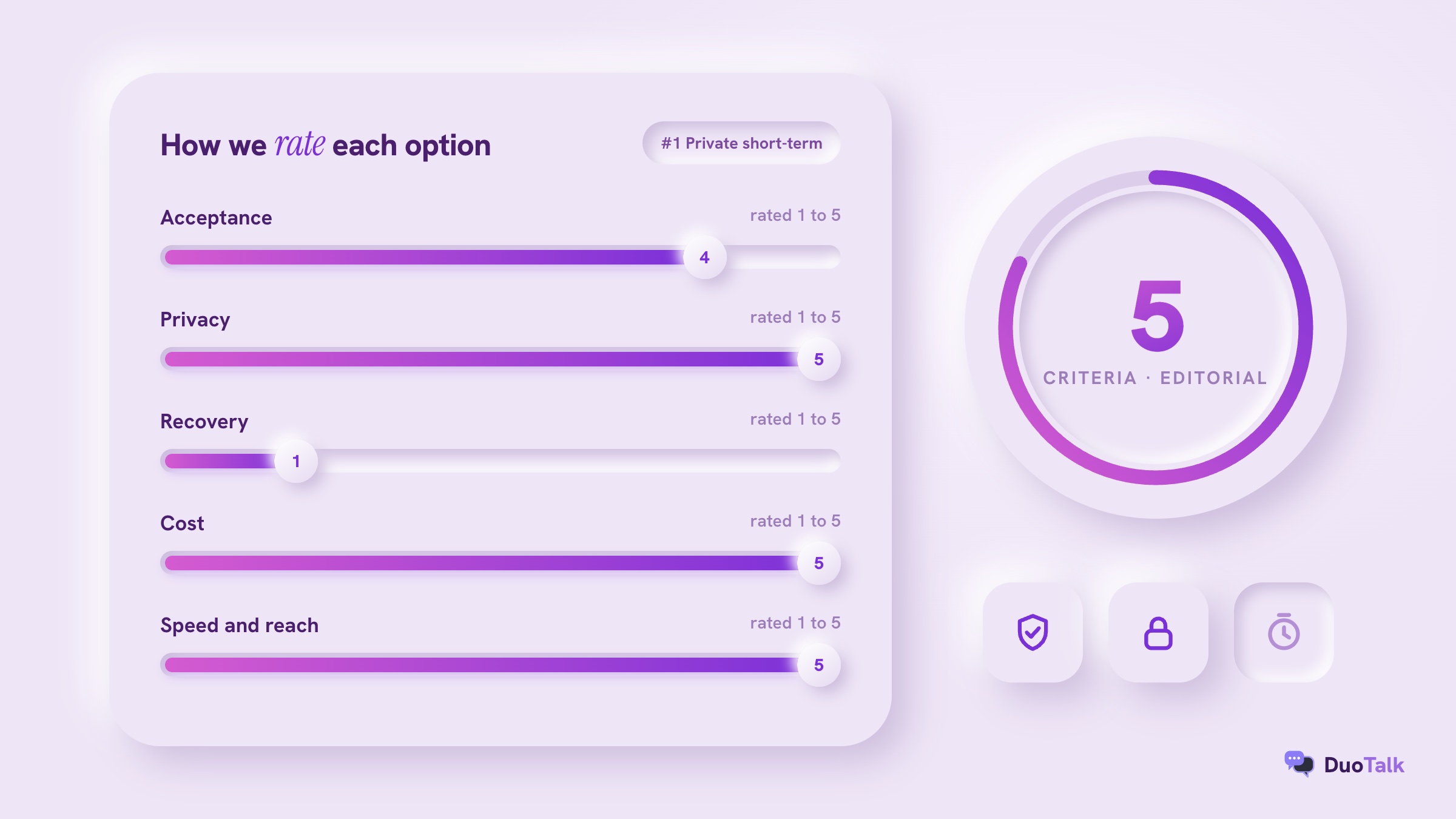
We rated every option from 1 to 5 on five criteria, then ordered the list with the weights below, which reflect how much each criterion decides whether a typical private sign-up works and stays safe. The ratings are our editorial judgment of how each option works, not user ratings, lab tests or measured success rates. One disclosure: DuoTalk sells the first two option types, so read the order with that in mind, and note that a different job (a bank account, a trip, a phone line people can call) puts a different option on top.
| Criterion | Weight | What a 5 means | What a 1 means |
|---|---|---|---|
| Acceptance | 30% | Real mobile line, accepted by nearly every service | Widely blocked or flagged |
| Privacy | 25% | Only you see the codes, number not tied to your ID | Codes visible to strangers, or tied to your legal identity |
| Recovery | 15% | You can keep the number for years | Gone within hours, cannot be recovered |
| Cost | 15% | Free or a few cents per code | A monthly plan or hardware |
| Speed and reach | 15% | Ready in minutes, many countries, no ID or extra device | Needs a shop visit, ID, a specific country or an existing number |
A higher place means a sensible default for a low-stakes sign-up you want to keep private, not the right pick for every case. A carrier line or a prepaid SIM sits below a private short-term number on this list, yet either one is the better pick for a bank, a payment app or any account you cannot afford to lose.
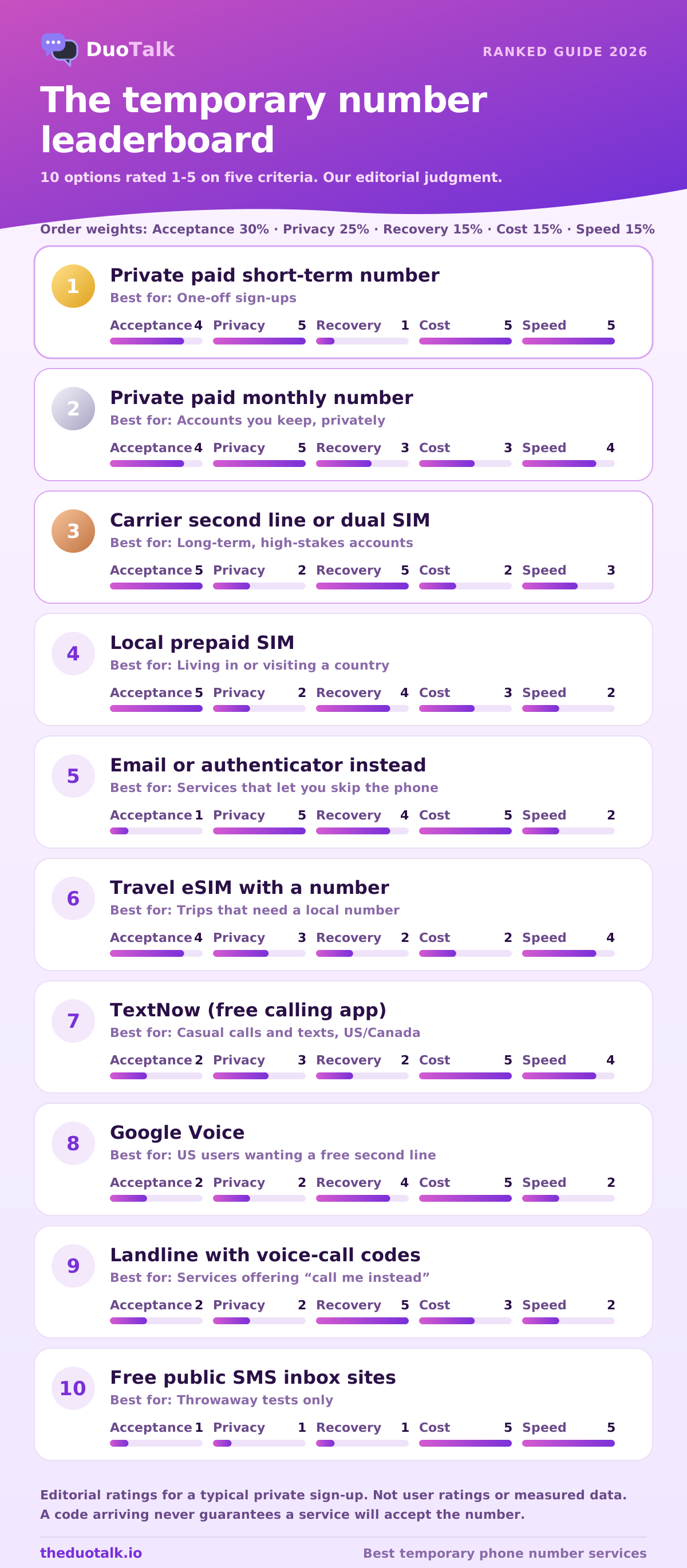
The full leaderboard at a glance
| Rank | Option | Acceptance | Privacy | Recovery | Cost | Speed | Best for |
|---|---|---|---|---|---|---|---|
| 1 | Private paid short-term number | 4 | 5 | 1 | 5 | 5 | One-off sign-ups |
| 2 | Private paid monthly number | 4 | 5 | 3 | 3 | 4 | Accounts you keep, privately |
| 3 | Carrier second line or dual SIM | 5 | 2 | 5 | 2 | 3 | Long-term, high-stakes accounts |
| 4 | Local prepaid SIM | 5 | 2 | 4 | 3 | 2 | Living in or visiting a country |
| 5 | Email or authenticator instead of SMS | 1 | 5 | 4 | 5 | 2 | Services that let you skip the phone |
| 6 | Travel eSIM that includes a number | 4 | 3 | 2 | 2 | 4 | Trips that need a local number |
| 7 | TextNow (free calling app) | 2 | 3 | 2 | 5 | 4 | Casual calls and texts in the US/Canada |
| 8 | Google Voice | 2 | 2 | 4 | 5 | 2 | US users who want a free second line |
| 9 | Landline with voice-call codes | 2 | 2 | 5 | 3 | 2 | Services that offer "call me instead" |
| 10 | Free public SMS inbox sites | 1 | 1 | 1 | 5 | 5 | Throwaway tests only |
The 10 best temporary phone number services, ranked
Each entry gives a definition, how it behaves with codes, pros and cons, and a "best for" verdict.
1. Private paid short-term number
A private paid short-term number is a real number you buy for a single verification, read in a private online inbox that nobody else can open. It is the best temporary phone number for a one-off sign-up because it combines a mobile-type line, real privacy and a price per code rather than per month.
You pick the service and country, copy the number into the sign-up form, and the code appears in your inbox. DuoTalk (theduotalk.io) is one example of this type: a web app to receive SMS online where a short-term number stays open for 60 minutes, stays open 7 more minutes after the first code for a possible second one, can be extended once for free if no code arrives, and refunds to your balance if it still fails. Short-term numbers receive SMS only from the one service chosen at purchase.
Pros
- Codes go only to you, so nobody can sign in with them.
- Usually mobile-type numbers, which pass more line-type checks than app numbers.
- Pay per use, often well under a dollar in many countries.
- No SIM, no ID, no extra handset, ready in a minute.
Cons
- The number is gone after the window closes, so you cannot use it to log in or recover the account later.
- Receive-only: it cannot send texts or take calls.
- A service can still refuse the number after sending the code. Getting a code is not the same as being accepted.
Best for: one-time registrations, trials, downloads, a second account on a messaging app you may delete, and testing your own sign-up flow.
2. Private paid monthly number
A private paid monthly number is a dedicated number you hold for 30 days at a time, with the same private inbox as a short-term number. It is the better choice when you will log in again, because many services send a fresh code on a new device or a password reset.
On DuoTalk, monthly numbers receive SMS from any service, which matters if you use one number for several accounts. Nothing renews automatically: you renew from your numbers list before the 30 days end (the steps are in extending and renewing a number). If a monthly number never receives an SMS, you can ask for a refund within 48 hours under the refund policy.
Pros
- Private inbox with the same acceptance as a short-term number.
- You can receive codes again for re-login and recovery while you keep renewing.
- Works for several services on one number.
Cons
- Costs more than a one-off number and is offered in fewer countries.
- If you forget to renew, the number goes back to the pool and you lose that recovery route.
- Still receive-only, so it does not replace a phone line people can call.
Best for: social, shopping and community accounts you plan to keep, seller profiles, and any account where losing access would be annoying but where you do not want your personal number on file.
3. Carrier second line or dual SIM
A carrier second line is a full mobile number from a phone company, added as a second physical SIM or an eSIM on the phone you already own. It has the highest acceptance of any option because it is exactly what verification systems were designed for: a mobile number tied to a device.
Most recent phones support this. Apple says iPhone XS and later support Dual SIM, and newer models can hold two eSIMs at once (Apple Support). Our second phone number guide walks through setup on iPhone and Pixel.
Pros
- Accepted almost everywhere, including banks and payment apps.
- Calls, texts and data, so it works as a real second line.
- Yours as long as you pay, which makes it the safest recovery number.
Cons
- A monthly bill, even if you only need a few codes.
- Registered to you through billing or SIM registration, so it is not anonymous from the service's point of view.
- If you cancel, the carrier recycles the number to someone else. A Princeton study found that 171 of 259 available recycled numbers it sampled were still linked to accounts at major websites (Princeton).
Best for: banking, payment apps, government services, your main email recovery and any account you would be in real trouble without.
4. Local prepaid SIM
A local prepaid SIM is a pay-as-you-go card from a carrier in the country you are in. It gives you a genuine local mobile number, which is why we rate it 5 for acceptance, but it usually costs you on privacy and convenience.
According to GSMA research, the governments of 155 countries required SIM registration as of January 2020, which means showing an ID to activate a prepaid SIM in most of the world (GSMA). Prepaid lines also expire if you stop topping up; the exact grace period depends on the carrier.
Pros
- Real local mobile number, accepted like any resident's.
- Cheap to keep for a while if you top up regularly.
- Calls and texts work, not only codes.
Cons
- ID registration in most countries, so the number is linked to you.
- Needs a SIM slot or eSIM support and often a shop visit.
- Expiry rules vary and are easy to miss when you leave the country.
Best for: people living in or staying a long time in a country, and local services that insist on a resident number.
5. Email or authenticator app instead of SMS
The best "temporary number" is sometimes no number at all. Many services let you verify by email, and most large ones let you switch two-factor sign-in from SMS to an authenticator app or passkey once the account exists.
We rate it 1 on acceptance because it only works where a service offers it, but 5 on privacy. Security bodies prefer it too: NIST's digital identity guidelines (SP 800-63B-4) classify SMS and voice codes over the phone network as a "restricted" authenticator that organisations may use only after assessing the risks, and require them to offer at least one unrestricted alternative (NIST).
Pros
- Nothing to buy, nothing to expire.
- Authenticator codes are not exposed to SIM swap or number recycling.
- Backup codes give you a way back in if you lose your phone (Google Account Help).
Cons
- Many sign-ups still require a phone number at registration, with no way around it.
- You have to store backup codes safely, or you can lock yourself out.
Best for: turning off SMS after sign-up on any account that offers an authenticator, and services that accept email-only registration.
6. Travel eSIM that includes a phone number
A travel eSIM is a digital SIM profile you buy before or during a trip. Most travel eSIMs are data-only and come with no phone number at all, which makes them useless for SMS codes. Some plans do include a number that can receive texts, usually at a higher price than data-only plans.
Pros
- Mobile-type number from a real network in many cases.
- Installs in minutes on an eSIM-capable phone, no shop visit.
Cons
- Check the plan details: "data only" means no SMS.
- The number usually ends when the plan ends, so it is poor for recovery.
- Some providers still ask for ID, depending on the country.
Best for: travellers who need a local number to receive codes from ride-hailing, delivery or booking apps during a trip.
7. TextNow and similar free calling apps
TextNow is a free app that gives you a US or Canadian number for calls and texts over Wi-Fi or data. It is a genuine second line for chatting, but as a verification number it is weak: app numbers are usually labelled VoIP, and many services block VoIP at sign-up.
Free TextNow numbers can also be taken back if you do not use them; TextNow sells a paid add-on to lock in your number. Treat a free app number as something that may disappear.
Pros
- Free calls and texts, two-way, in the US and Canada.
Cons
- Frequently rejected for verification because of the VoIP label.
- Free numbers can be reclaimed after a period of inactivity.
- Ads and data collection are part of the free model.
Best for: casual calls and texts with people you do not want to give your main number, not for sign-up codes that matter.
8. Google Voice
Google Voice is Google's free calling and texting number. For personal accounts it is available only in the US, and setup asks you to verify an existing phone number, so it is not a way around having one (Google Voice on the App Store).
As a verification number it has the same VoIP problem as other apps. OpenAI, for example, states that it does not accept Google Voice or other VoIP numbers for phone verification (OpenAI Help Center). Google also reclaims inactive numbers; you get a warning with a "reclaim date" and 45 days after it to get the number back (Google Voice Help).
Pros
- Free, stable if you use it, with calls, texts and voicemail.
- Good for giving to people and businesses instead of your mobile number.
Cons
- US only for personal accounts, and needs an existing number to set up.
- Commonly refused by apps that check line type.
- Linked to your Google account, so it is not a separate identity.
Best for: US residents who want a free public-facing number for calls and messages.
9. Landline that receives voice-call codes
Some services offer a "call me instead" option that reads the code aloud, which means a landline can work. Google, for example, lets you get 2-Step Verification codes by voice call. Wording and availability vary by service, and many sign-up forms reject landline numbers outright.
Pros
- Very stable: landlines rarely change and are not easily SIM-swapped.
- Useful as a backup recovery phone where voice calls are offered.
Cons
- Most apps only send SMS, and some explicitly refuse landlines.
- Tied to your address and name.
Best for: a household backup number on services that support voice delivery.
10. Free public SMS inbox sites
A free public SMS inbox site lists numbers on a web page, and every message sent to those numbers appears on that page for anyone to read. They are free and instant, and that is all.
Because the inbox is public, anyone who sees your code can use it while it is valid, and anyone can later press "forgot password" on your account and read the reset code. The numbers are also heavily reused, so popular services have usually blocked them already. We do not name or link these sites. Our comparison of free vs paid SMS verification shows the risk scenarios in detail, and our temporary phone number for verification guide covers how to stay safe if you use one.
Pros
- Free and needs no account.
Cons
- Every code is public.
- Most numbers are already blocked by large services.
- No way to receive a code later or recover the account.
Best for: testing whether a form sends SMS at all, with a throwaway account you never plan to use.
Which temporary number option fits you?
The right option depends on two questions: will you need this account again, and how strict is the service? Answer those and the choice is usually obvious.
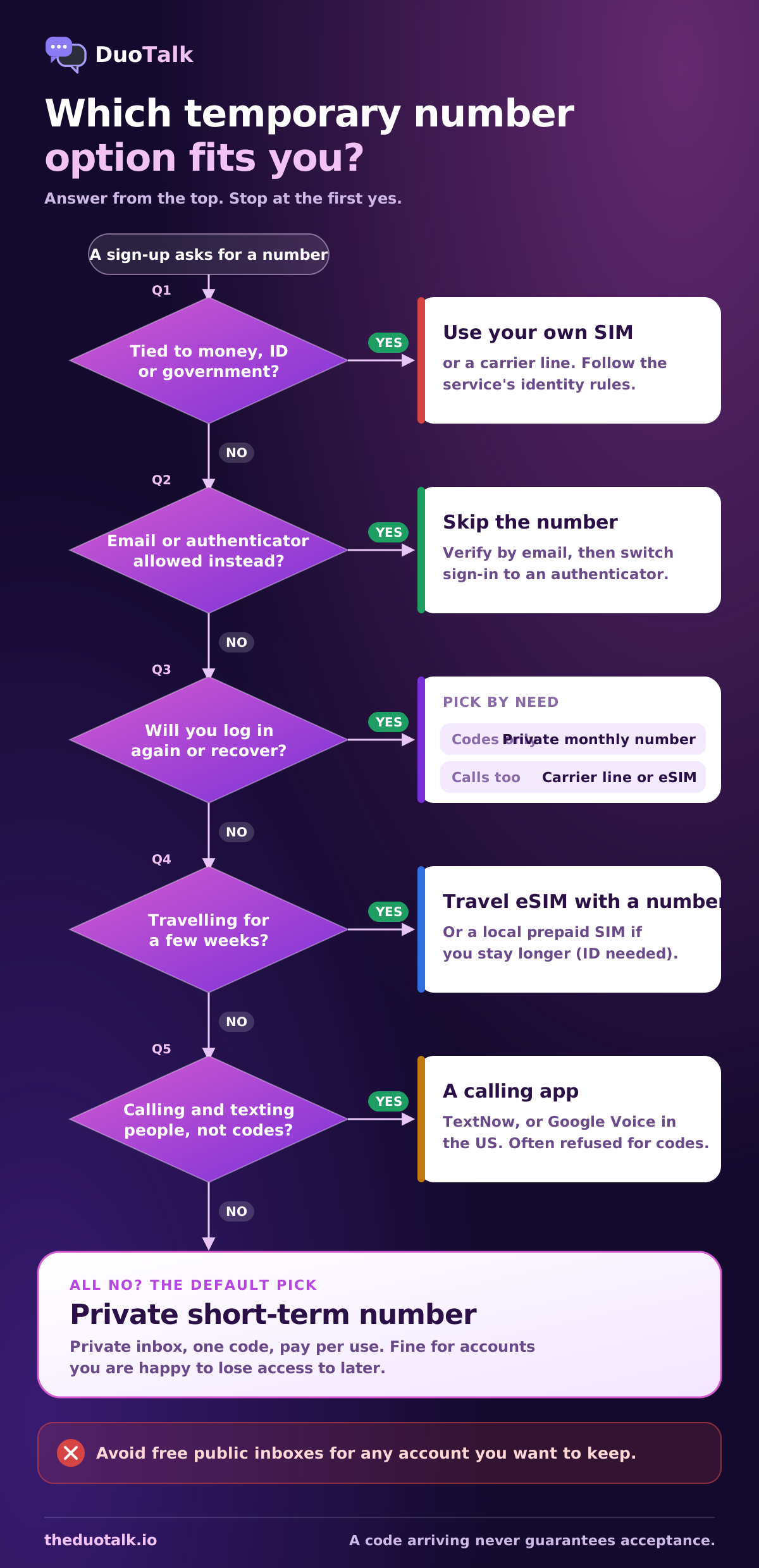
Use these decision rules:
- Is the account tied to money, identity or government services? Use your own SIM or a carrier second line. Follow the service's identity rules. No temporary number is appropriate here.
- Will you log in again or need recovery? Use a private monthly number, or a carrier line if the account is important.
- Is it a one-off sign-up you may delete? Use a private short-term number.
- Does the service let you verify by email or switch to an authenticator? Do that, and keep your number off the account altogether.
- Are you travelling and need a local number for a few weeks? A travel eSIM with a number, or a local prepaid SIM if you are staying longer.
- Do you want to call and text people from a second number? A calling app (TextNow, or Google Voice in the US) or a carrier line, not a receive-only number.
Best picks by job
| Job | Best pick | Runner-up | Avoid |
|---|---|---|---|
| One-time sign-up or trial | Private short-term number | Email-only sign-up, if offered | Public inbox |
| Social or shopping account you keep | Private monthly number | Carrier second line | Short-term number |
| Banking, payments, crypto exchanges | Your own SIM or carrier line | Local prepaid SIM in your name | Any temporary number |
| Messaging app on a second device | Private monthly number | Carrier eSIM | Public inbox |
| Travel for 1-4 weeks | Travel eSIM with a number | Private short-term number for single codes | Data-only eSIM (no SMS) |
| Developer testing your own SMS flow | Private short-term number | A test number from your own SMS provider | Public inbox (leaks test data) |
| Calls with strangers (marketplace, dating) | Calling app or carrier line | Google Voice (US) | Receive-only numbers |
Free vs cheap SMS verification numbers: what you actually pay
A cheap SMS verification number usually costs less than a coffee, while a "free" one can cost you the account. The real price of a temporary number is the money you pay plus the chance of losing access later.
Free options charge in other ways:
- Public inboxes cost you privacy: your code and your account's recovery route are visible to everyone.
- Free apps cost you reliability: VoIP labels lead to rejections, and inactive numbers are reclaimed.
- Recycled numbers cost you security: when any number is reassigned, the next owner can receive your codes. The Princeton team found 19 of 200 recycled numbers they held for a week were still receiving security or privacy messages meant for previous owners (Princeton).
Paid options charge money but buy something specific: a private inbox, a mobile-type line and a refund route if no code arrives. For a breakdown of what drives price, see our guide to SMS verification cost, or see live prices for each service and country on the Numbers page.
How to keep verification costs low without cutting corners
- Use a short-term number only for accounts you are happy to lose.
- Put several keeper accounts on one monthly number instead of buying many short-term numbers.
- Enter the number in the correct international format the first time; a wrong digit wastes the window.
- Wait for one code before pressing "resend" several times, which can trigger rate limits on the service's side.
- If no code arrives, use the free extension or the refund instead of buying a second number straight away.
How to use a temporary number for verification, step by step
These steps apply to any private number service.
- Decide the duration first. One-off account: short-term. Keeper account: monthly.
- Pick the exact service and country. Short-term numbers are tied to the one service you choose, so choose the app you are signing up for, not a similar one.
- Check stock and price. On DuoTalk this is the live list on the Numbers page.
- Copy the number in international format. Include the country code (+1, +44 and so on) and drop any leading zero the form adds twice.
- Request the code in the app and watch your inbox. Codes usually arrive within seconds on tested routes.
- Enter the code promptly. Many codes expire in a few minutes; the exact time varies by service.
- Secure the account. Add an email, switch two-factor sign-in to an authenticator where possible, and save backup codes.
- If nothing arrives, check the troubleshooting list below before buying again.
When a temporary number fails: causes and fixes
A temporary number fails for one of two reasons: the code never arrives, or it arrives and the service rejects the number anyway. They have different fixes.
| What you see | Likely cause | What to do |
|---|---|---|
| No code after a few minutes | Service did not send, or delivery is delayed | Check the number and country code, press resend once, then extend or report the number |
| "This phone number cannot be used for verification" (wording varies) | Line-type check flagged VoIP or a known virtual range | Switch to a mobile-type private number or a carrier line |
| "Too many attempts" (wording varies) | Rate limit on your device, IP or the number | Wait before retrying; do not cycle through many numbers quickly |
| Code arrives but sign-up fails later | The service decided the account is risky | Use a number you can keep, and complete the profile normally |
| Code arrives for the wrong service | Short-term numbers receive only from the service chosen | Buy for the exact service you are signing up to |
Red flags when choosing a temporary phone number service
Walk away from any service that shows these warning signs.
- Public or shared inbox for paid numbers. If you cannot tell whether others can see your messages, assume they can.
- No refund or retry rule when no code arrives. A clear policy should say what happens if the SMS never comes.
- Promises that every service will accept the number. Nobody controls another company's acceptance rules. Honest services say a code arriving is not a guarantee.
- Encouragement to evade bans or create accounts in bulk. That breaks the target service's terms and puts your accounts at risk.
- No way to keep the number when you clearly need recovery later.
Safety rules that apply to every option
A few rules keep any temporary number from turning into a lost account.
- Never put a temporary number on a bank, payment app or government account. Use a number you will hold for years.
- Add an email for recovery and switch two-factor sign-in away from SMS when the service allows it.
- Protect your real number from SIM swap. In the US, the FCC adopted rules in November 2023 requiring wireless carriers to use secure authentication before SIM changes and number ports and to notify customers of those requests (Federal Register). Ask your carrier about a port-out lock or account PIN.
- Respect each platform's rules. A temporary number is a privacy tool, not a way around a ban or an identity check.
Where DuoTalk fits in this list
DuoTalk covers options 1 and 2: private short-term numbers for one-off codes and private monthly numbers for accounts you keep. Both are receive-only and read in a private inbox. Top-ups are in crypto, payment comes from your DuoTalk balance with no fees added at checkout, and if a short-term number gets no code you can extend once for free and then report it for a refund to your balance. For anything tied to your identity or money, the honest answer from this ranking is still option 3: your own carrier line.
Questions people also ask
What is the best temporary phone number service?
The best temporary phone number service for a one-off sign-up is a private paid short-term number, because only you can read the code and the line is usually mobile-type. For accounts you will use again, a private monthly number is better, and for banking or payments use your own carrier line. Free public inbox sites rank last because anyone can read the codes sent to them.
Is it safe to use a temporary phone number for verification?
It is safe when the inbox is private and the account is low-stakes. The risk is not the code itself but recovery: if the service later sends a login or reset code to a number you no longer hold, you can be locked out. Public inboxes are unsafe because strangers can read your codes. Never use a temporary number for banking, payments or government accounts.
Can I get a temporary phone number for free?
Yes, but free options come with trade-offs. Free calling apps such as TextNow give you a US or Canadian number, but many services reject them as VoIP and inactive numbers can be reclaimed. Free public inbox sites cost nothing but show every code to everyone. A cheap paid private number is usually the safer choice for anything you care about.
Does Google Voice work for SMS verification?
Sometimes, but often not. Google Voice numbers are usually treated as VoIP, and several services, including OpenAI, state that they do not accept Google Voice for phone verification. For personal use Google Voice is available only in the US and needs an existing number to set up. It works better as a free public-facing number for calls and texts.
How long does a temporary phone number last?
It depends on the type. Private short-term numbers usually last minutes to an hour; on DuoTalk the window is 60 minutes, plus 7 minutes after the first code. Monthly numbers last 30 days per renewal. Prepaid SIMs and app numbers last until you stop topping up or using them, and carrier lines last as long as you pay.
What is the cheapest SMS verification number?
The cheapest working option is usually a private short-term number paid per code, which often costs well under a dollar in many countries. Free apps and public inboxes cost nothing upfront but are often rejected or unsafe, so you may pay later in lost accounts. Check live prices per service and country before buying, because they vary with demand and stock.
Can I use a temporary number for WhatsApp or Telegram?
You can, but think about recovery first. Messaging apps re-verify your number when you change phones, so a number that expires after an hour can lock you out. For a messaging account you plan to keep, use a private monthly number or a carrier line. A short-term number suits a test account or a second account you may delete.
Sources
- NIST SP 800-63B-4: Authentication and Authenticator Management (PSTN as a restricted authenticator)
- GSMA: Access to Mobile Services and Proof of Identity 2020 (155 countries mandate SIM registration)
- Apple Support: Use Dual SIM with an eSIM
- Google Voice Help: Google Voice reclaims inactive numbers
- Google Voice on the App Store (personal accounts available in the US)
- OpenAI Help Center: Can I use a premium number, landline, Google Voice or other VoIP phone number?
- Google Account Help: Sign in with backup codes
- Princeton University, Lee and Narayanan: Security and Privacy Risks of Number Recycling at Mobile Carriers
- Federal Register: FCC rules on SIM swap and port-out fraud (December 8, 2023)
Last reviewed: November 2026